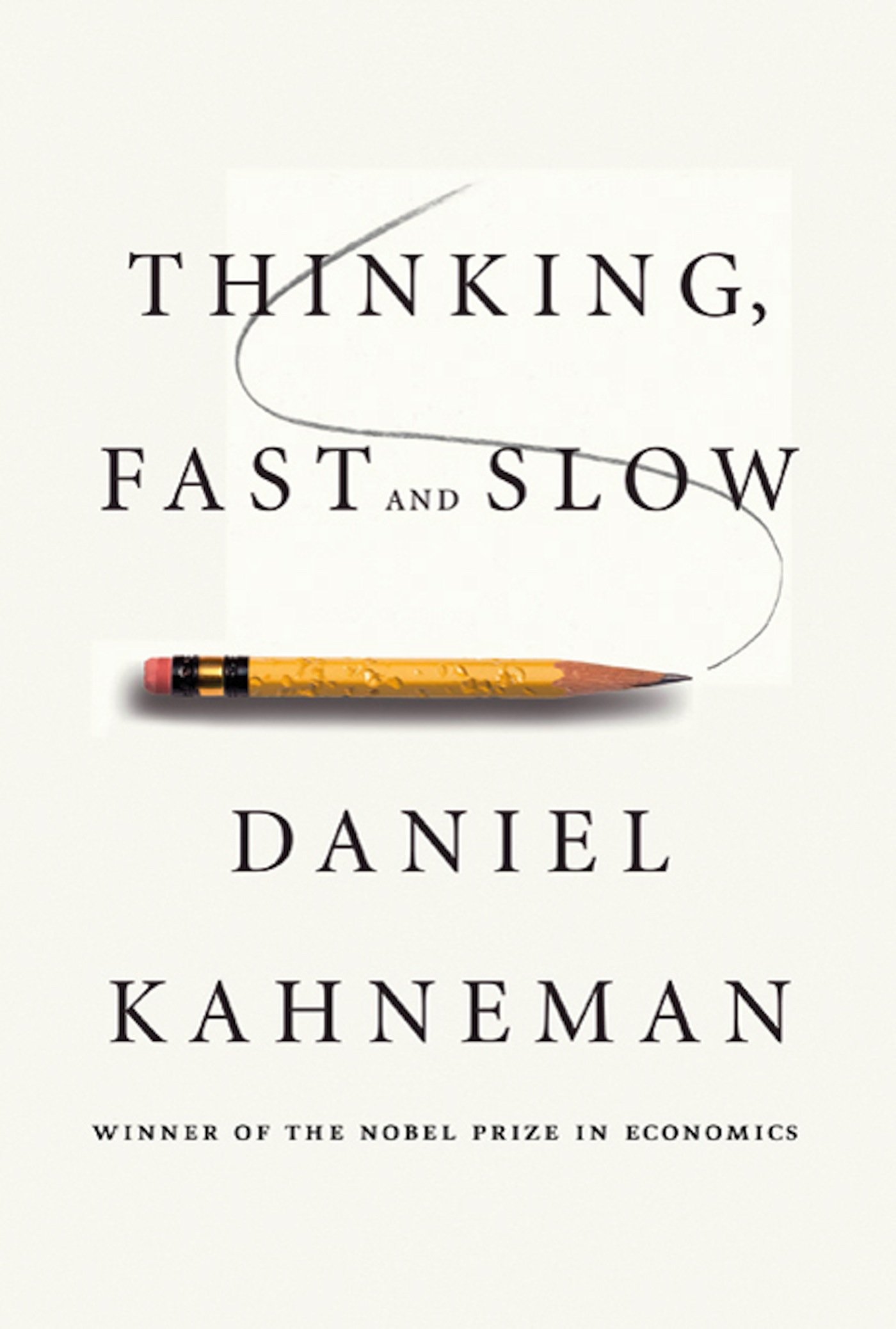
Book cover of Thinking:Fast and Slow

Thinking:Fast and Slow Summary

Meditation & Health

By Daniel Kahneman

Farrar, Straus and Giroux · October 25, 2011

Summary

"Thinking: Fast and Slow" by Daniel Kahneman is a groundbreaking exploration of the human mind's decision-making processes. The book presents two distinct systems of thought. System 1 is fast, intuitive, and effortless, making snap judgments based on past experiences and associations. System 2, on the other hand, is slow, deliberate, and requires mental effort. It's used for complex problem-solving. Kahneman draws on decades of psychological research, sharing numerous real-life scenarios to illustrate how these two systems interact. He uncovers the many cognitive biases that affect our daily choices, from simple decisions like what to eat to major ones like investing. Understanding these biases can help us make better, more rational decisions. Whether in business, personal life, or public policy, the lessons from this book can be applied widely. It's a must-read for anyone interested in understanding human behavior and improving decision-making.

About the Author

Daniel Kahneman is a renowned psychologist and Nobel laureate. He focuses on behavioral economics and psychology. His writing in "Thinking: Fast and Slow" is clear-cut, blending research with real-life examples to explore cognitive biases.

Chapters

1

Introduction to Dual-Process Thinking

In "Thinking: Fast and Slow," we are introduced to the concept of dual-process thinking. There are two systems at work in our minds. System 1 is fast, intuitive, and automatic. It operates effortlessly and quickly, making snap judgments and associations. For example, when you see a dog running towards you, your immediate feeling of whether it's friendly or not is a result of System 1. It relies on heuristics, which are mental shortcuts that help us make rapid decisions.System 2, on the other hand, is slow, deliberate, and effortful. It is used for complex problem-solving, logical reasoning, and concentration. When you're calculating a difficult math problem, you are engaging System 2. System 2 requires more energy and attention, and we tend to avoid using it when possible because it's tiring.The balance between these two systems is crucial. System 1 is great for day-to-day situations where quick responses are needed, but it can also lead to biases and errors. System 2 can correct these mistakes, but it may not always be activated when it should be. Understanding these two systems is the foundation for grasping how our minds work and how we make decisions.

2

Cognitive Biases in System 1

System 1 is prone to a variety of cognitive biases. One of the most well-known is the anchoring bias. This occurs when we rely too heavily on the first piece of information we receive. For instance, when negotiating the price of a car, if the salesperson starts with a high price, that price becomes an anchor, and our subsequent offers are influenced by it.The availability heuristic is another common bias. We judge the likelihood of an event based on how easily examples come to mind. If we hear a lot about plane crashes in the news, we may overestimate the probability of being in a plane crash, even though statistically, it's a very rare event.The representativeness heuristic leads us to judge the probability of an event based on how well it matches a particular prototype. For example, if someone is described as quiet, wears glasses, and likes to read, we might assume they are a librarian, even though there are many other occupations that fit that description. These biases can lead to inaccurate judgments and poor decision-making.

3

Overconfidence and Illusion of Knowledge

We often have an inflated sense of our own knowledge and abilities. This overconfidence can lead us to make risky decisions. In the financial world, investors may be overconfident in their ability to pick stocks. They may think they have special insights that others don't, leading them to take on more risk than they should.The illusion of knowledge is related to overconfidence. We believe we know more than we actually do. We may think we understand complex systems like the economy or the stock market in great detail, but in reality, our understanding is often limited. This can lead to bad decisions, such as making large investments without fully understanding the risks.Overconfidence can also affect our predictions. We tend to be overly certain about the future, whether it's predicting the outcome of a sports game or the success of a new business venture. This can result in disappointment and financial losses when our predictions turn out to be wrong.

4

Framing Effects

The way information is presented, or framed, can have a significant impact on our decisions. For example, if a medical treatment is described as having a 90% survival rate, it sounds more appealing than if it's described as having a 10% death rate, even though the two statements are logically equivalent.Framing effects can also influence our choices in other areas. When presented with a choice between a product that has a small discount and one that has a small surcharge, we are more likely to choose the product with the discount, even if the overall cost is the same.Marketers and politicians often use framing to influence our decisions. By presenting information in a certain way, they can make their products or policies seem more attractive. Understanding framing effects can help us make more rational decisions by looking beyond the way information is presented.

5

Prospect Theory

Prospect theory challenges the traditional economic view of decision-making under risk. It shows that people do not always make decisions based on maximizing expected utility. Instead, we are more sensitive to losses than to gains.For example, losing $100 causes more pain than the pleasure we get from gaining $100. This asymmetry in our perception of gains and losses can lead to risk-averse behavior when it comes to gains and risk-seeking behavior when it comes to losses.In a situation where we have a choice between a sure gain and a risky gain, we are more likely to choose the sure gain. But when faced with a sure loss and a risky loss, we are more likely to take the risk in the hope of avoiding the loss. Prospect theory helps explain many real-world phenomena, such as why people hold on to losing stocks for too long.

5 more chapters available

Continue listening in the Spickor app — free download on the App Store.

Listen in App

Why Spickor?

At Spickor, we believe knowledge should have no paywalls. Every book summary can be unlocked for free by watching a short ad — or you can choose an ad-free subscription. Unlike other apps, there's no "1 book per day" free limit. Learn at your own pace, on your own terms.

FeatureSpickorBlinkistHeadway
Free accessAll books free via ad unlock1 book/day only1 book/day only
Book library2,200+ across 8 categories9,000+ (non-fiction only)2,000+ (personal growth focus)
Paid subscriptionNo forced subscription; ad-supportedRequired; from $99.99/yrRequired; from $89.99/yr
Audio for all summariesYesPremium onlyPremium only
Novels & fictionYesNoNo
PlatformsiOS (Android & Web in dev)iOS / Android / WebiOS / Android only

All Books, Truly Free

Unlock any book with a short ad. No daily limits, no hidden fees.

Listen for Free

Every summary includes high-quality audio. No "premium only" labels.

Beyond Self-Help

8 categories including business, technology, and novels.

Listen in App
10 m 01 s