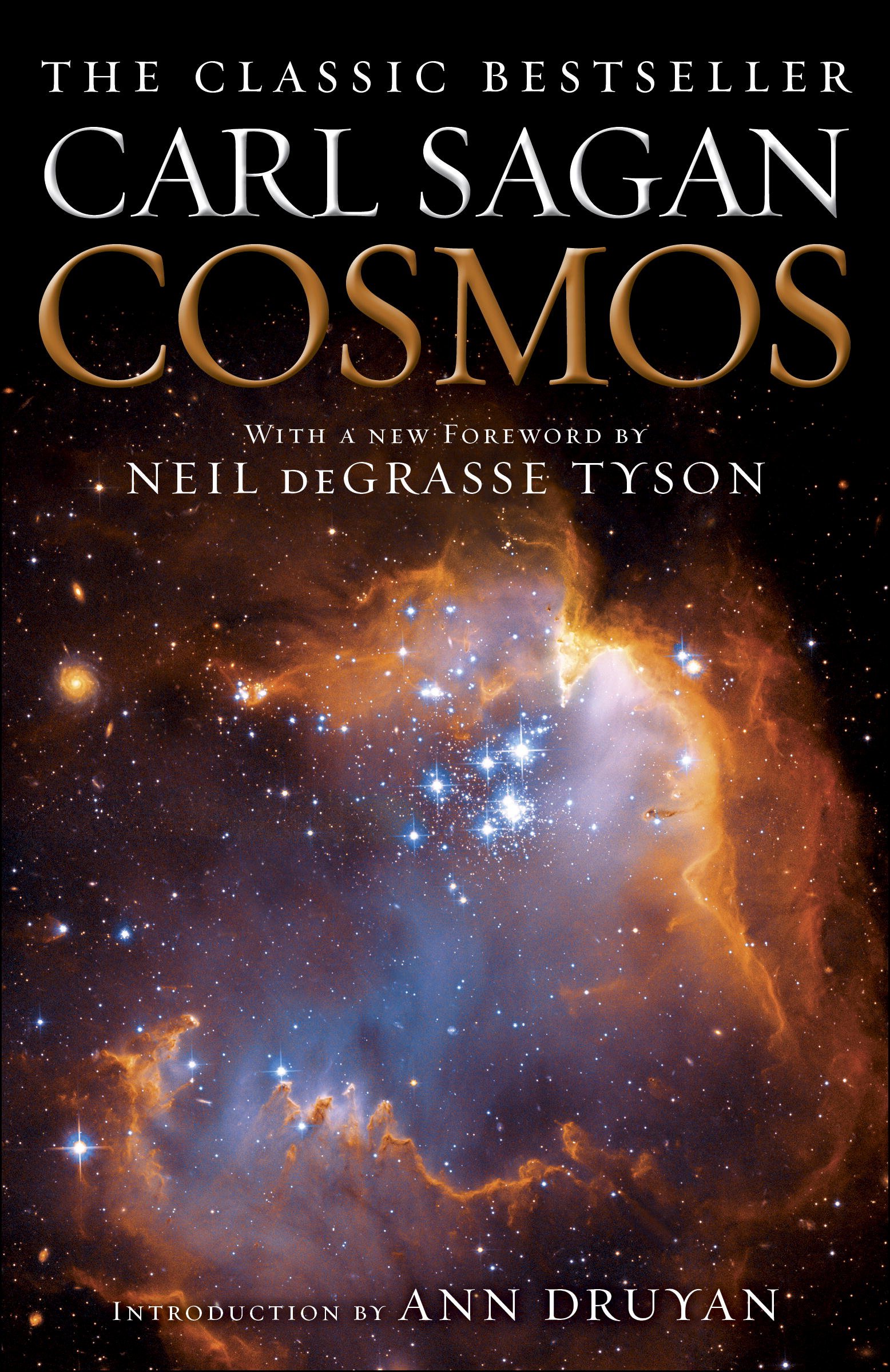
Book cover of Cosmos

Cosmos Summary

Technology & Science

By Carl Sagan

Ballantine Books · July 6, 2011

Summary

Cosmos, penned by the renowned astronomer Carl Sagan, is a masterpiece that delves into the mysteries of the universe. The book starts by introducing the basic building blocks of matter and then gradually expands to explore the vastness of space. Sagan takes readers on an epic journey, from the birth of stars and planets to the search for extraterrestrial life. Through vivid descriptions and thought-provoking insights, he makes the universe come alive. Whether it's explaining the formation of nebulae or the concept of time dilation, Sagan's writing is both educational and entertaining. He encourages readers to think critically about our existence and the nature of the cosmos. This book is not just a scientific treatise; it's an invitation to explore the unknown and to be in awe of the universe we inhabit.

About the Author

Carl Sagan was an American astronomer and science writer. He specialized in popularizing science. His writing in "Cosmos" is engaging, blending scientific facts with vivid storytelling, making complex concepts accessible.

Chapters

1

The Cosmos: An Overview

The cosmos is a vast and mysterious expanse that encompasses everything we know and much that we don't. It includes stars, planets, galaxies, and all the matter and energy in the universe. Carl Sagan takes us on a journey through the cosmos, exploring its wonders and mysteries.The scale of the cosmos is truly mind-boggling. There are billions of stars in our galaxy, the Milky Way, and there are billions of galaxies in the observable universe. Our solar system, with the Sun at its center and the planets orbiting around it, is just a tiny part of this vast cosmic structure.The study of the cosmos helps us understand our place in the universe. It makes us realize how small and insignificant we are on a cosmic scale, but also how unique and precious life on Earth is. We are made of the same elements that were forged in the hearts of stars, and the processes that occur in the cosmos have a direct impact on our existence.


2

The Birth of the Universe

The universe as we know it began with the Big Bang. This was an event that occurred approximately 13.8 billion years ago. At the moment of the Big Bang, all the matter and energy in the universe was concentrated in an extremely hot and dense point.As the universe expanded and cooled, subatomic particles began to form. These particles combined to form atoms, mainly hydrogen and helium. Over time, gravity caused these atoms to come together and form clouds of gas. These gas clouds eventually collapsed under their own gravity to form stars.The first stars were massive and short-lived. They burned through their fuel quickly and ended their lives in spectacular supernovae explosions. These explosions scattered heavy elements, such as carbon, oxygen, and iron, into the surrounding space. These elements are essential for the formation of planets and life as we know it.The process of star formation and death is an ongoing cycle in the universe. New stars are constantly being born, and old stars are dying. This cycle has been going on for billions of years and will continue for billions more.

3

Stars: The Engines of the Cosmos

Stars are the fundamental building blocks of the cosmos. They are massive balls of gas that generate energy through nuclear fusion. In the core of a star, hydrogen atoms are fused together to form helium, releasing a tremendous amount of energy in the process.The life cycle of a star depends on its mass. Smaller stars, like our Sun, will go through a relatively peaceful life. They will eventually exhaust their hydrogen fuel and expand into red giants. After this phase, they will shed their outer layers and form a white dwarf.Larger stars, on the other hand, have a more dramatic life cycle. They can become supergiants and end their lives in a supernova explosion. The remnants of a supernova can form a neutron star or, in the case of extremely massive stars, a black hole.Stars also play a crucial role in the formation of elements. The nuclear fusion processes inside stars create heavier elements from lighter ones. When a star explodes as a supernova, these elements are scattered into space, where they can be incorporated into new stars, planets, and eventually, living organisms.

4

Planets and Moons

Our solar system is home to eight planets, along with numerous moons, asteroids, and comets. Each planet has its own unique characteristics. Mercury is the closest planet to the Sun and has a very thin atmosphere. Venus has a thick, toxic atmosphere that traps heat, making it the hottest planet in the solar system.Earth is the only planet known to support life. It has a moderate climate, liquid water, and a protective atmosphere. Mars, often called the "Red Planet," has a thin atmosphere and evidence of past water flow.Jupiter is the largest planet in the solar system. It is a gas giant with a powerful magnetic field and a large number of moons. Saturn is famous for its beautiful rings, which are made up of ice and rock particles. Uranus and Neptune are ice giants, with cold temperatures and unique atmospheres.Moons are natural satellites that orbit planets. Some moons, like Jupiter's moon Europa and Saturn's moon Enceladus, are thought to have subsurface oceans, which could potentially harbor life.

5

Life in the Cosmos

The question of whether life exists elsewhere in the cosmos is one of the most fascinating in science. Given the vast number of stars and planets in the universe, it seems likely that there are other places where life could have evolved.The conditions necessary for life as we know it include liquid water, a source of energy, and the presence of certain chemical elements. Scientists are searching for exoplanets, planets outside our solar system, that might have these conditions.The Drake Equation is a tool used to estimate the number of intelligent civilizations in the Milky Way galaxy. It takes into account factors such as the rate of star formation, the fraction of stars with planets, the number of habitable planets per star, and the probability of life evolving on those planets.Even if life exists elsewhere, it may be very different from life on Earth. It could have a different biochemistry or evolutionary path. The search for extraterrestrial life is an ongoing and exciting area of research.

5 more chapters available

Continue listening in the Spickor app — free download on the App Store.

Listen in App

Why Spickor?

At Spickor, we believe knowledge should have no paywalls. Every book summary can be unlocked for free by watching a short ad — or you can choose an ad-free subscription. Unlike other apps, there's no "1 book per day" free limit. Learn at your own pace, on your own terms.

FeatureSpickorBlinkistHeadway
Free accessAll books free via ad unlock1 book/day only1 book/day only
Book library2,200+ across 8 categories9,000+ (non-fiction only)2,000+ (personal growth focus)
Paid subscriptionNo forced subscription; ad-supportedRequired; from $99.99/yrRequired; from $89.99/yr
Audio for all summariesYesPremium onlyPremium only
Novels & fictionYesNoNo
PlatformsiOS (Android & Web in dev)iOS / Android / WebiOS / Android only

All Books, Truly Free

Unlock any book with a short ad. No daily limits, no hidden fees.

Listen for Free

Every summary includes high-quality audio. No "premium only" labels.

Beyond Self-Help

8 categories including business, technology, and novels.

Listen in App
10 m 29 s