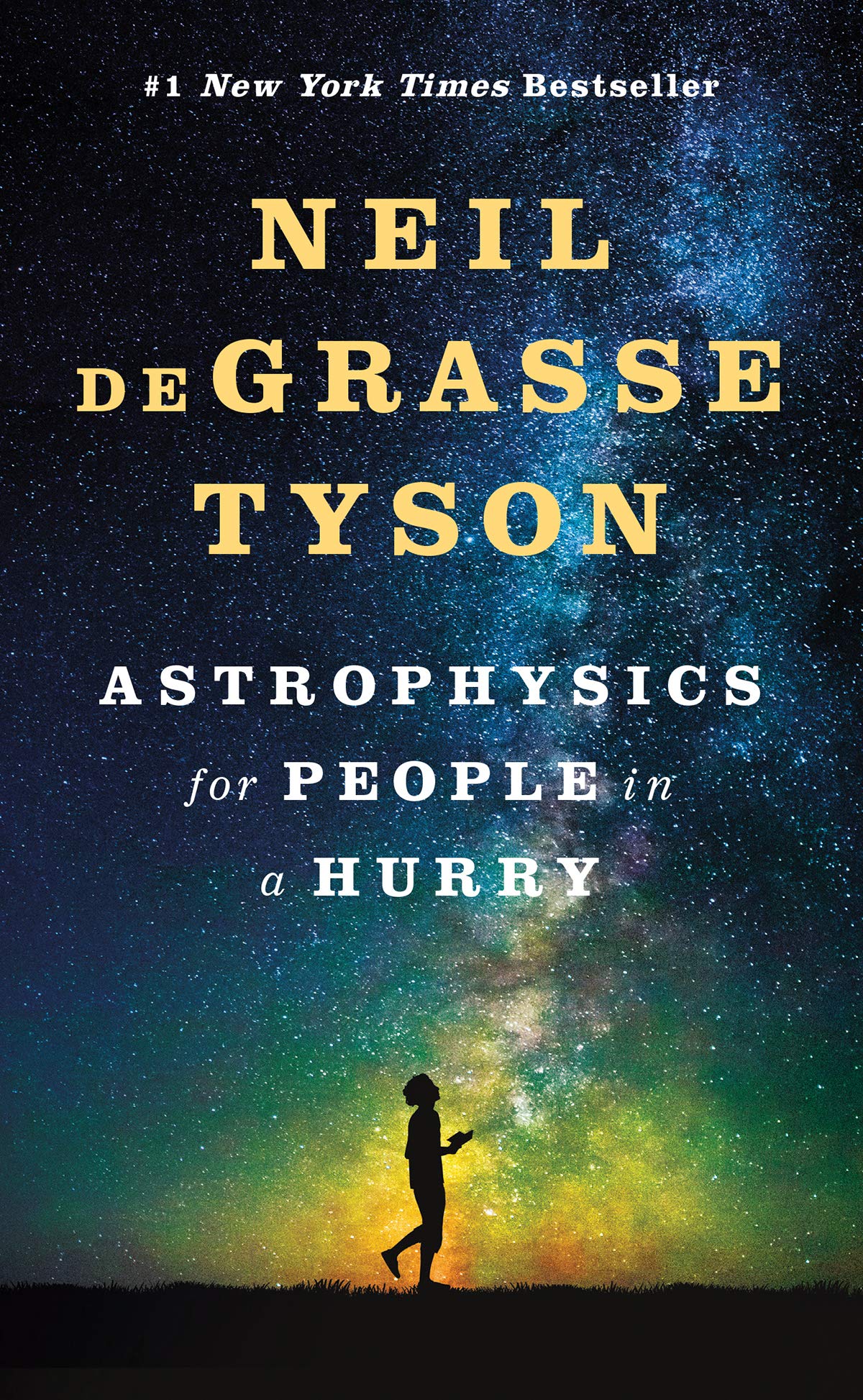
Book cover of Astrophysics for People in a Hurry

Astrophysics for People in a Hurry Summary

Technology & Science

By Neil de Grasse Tyson

W. W. Norton & Company · May 2, 2017

Summary

Astrophysics for People in a Hurry, penned by the renowned Neil deGrasse Tyson, is a remarkable book that caters to those with a thirst for knowledge about the universe but limited time. Tyson, a well-known astrophysicist, takes readers on an exhilarating tour of space. He breaks down difficult astrophysical ideas into easy-to-understand explanations. From the birth of stars to the mysteries of black holes, the book covers a wide range of topics. It presents complex theories in a way that doesn't require a background in science. Whether you're waiting for a bus or have a few minutes before bed, this book allows you to dip into the wonders of the cosmos. It turns the vastness of the universe into bite-sized, understandable pieces, making it a perfect read for those curious about the stars and galaxies.

About the Author

Neil deGrasse Tyson is a renowned astrophysicist. He writes in the field of astrophysics. His style in "Astrophysics for People in a Hurry" is accessible, making complex concepts easy for general readers.

Chapters

1

Introduction to Astrophysics

Astrophysics is the branch of astronomy that deals with the physical properties and processes of celestial objects. In "Astrophysics for People in a Hurry," Neil deGrasse Tyson takes readers on a whirlwind tour of the universe, explaining complex astrophysical concepts in a clear and accessible way. This book is designed for those who want to gain a basic understanding of the cosmos without getting bogged down in technical details.


2

The Cosmos and Its Origins

The universe is vast and mysterious, and its origins have puzzled humans for centuries. Current scientific understanding suggests that the universe began with the Big Bang, a singularity from which all matter and energy emerged. In the first moments after the Big Bang, the universe was extremely hot and dense. As it expanded, it cooled, allowing matter to form. This led to the creation of atoms, stars, and galaxies.The Big Bang theory is supported by several lines of evidence. One of the most significant is the cosmic microwave background radiation, which is a faint glow of radiation that fills the entire universe. This radiation is thought to be the afterglow of the Big Bang and provides strong evidence for the theory. Another piece of evidence is the observed expansion of the universe. Galaxies are moving away from each other, and the farther away they are, the faster they are moving. This suggests that the universe is constantly expanding.

3

Stars and Their Life Cycles

Stars are the building blocks of galaxies and play a crucial role in the universe. They are massive, luminous spheres of plasma held together by their own gravity. The life cycle of a star begins with the collapse of a cloud of gas and dust, known as a nebula. As the cloud collapses, it heats up, and nuclear fusion begins in its core. This is the process by which hydrogen atoms combine to form helium, releasing a tremendous amount of energy in the form of light and heat.The size of a star determines its life cycle. Smaller stars, like our Sun, will eventually run out of hydrogen fuel and expand into red giants. After shedding their outer layers, they will become white dwarfs, which are dense, hot remnants of stars. Larger stars, on the other hand, will end their lives in a spectacular explosion called a supernova. A supernova can be so bright that it outshines an entire galaxy for a short period. After a supernova, the core of the star may collapse to form a neutron star or a black hole.

4

Galaxies and Their Structures

Galaxies are vast systems of stars, gas, dust, and dark matter held together by gravity. There are several types of galaxies, including spiral galaxies, elliptical galaxies, and irregular galaxies. Spiral galaxies, like the Milky Way, have a distinct spiral shape with a central bulge and arms that wind around it. Elliptical galaxies are more spherical or oval in shape and contain older stars. Irregular galaxies have no distinct shape and are often the result of galaxy collisions.Galaxies are not randomly distributed in the universe but are organized into clusters and superclusters. These large-scale structures are connected by filaments of gas and dark matter. The study of galaxies helps us understand the evolution of the universe and how matter has clumped together over time.

5

Dark Matter and Dark Energy

Dark matter and dark energy are two of the most mysterious components of the universe. Dark matter is a form of matter that does not interact with light or other forms of electromagnetic radiation, making it invisible. However, its presence can be inferred from its gravitational effects on visible matter. For example, the rotation curves of galaxies suggest that there is more mass in galaxies than can be accounted for by visible stars and gas. This additional mass is thought to be dark matter.Dark energy, on the other hand, is a hypothetical form of energy that is causing the expansion of the universe to accelerate. It is estimated to make up about 68% of the total energy density of the universe, while dark matter accounts for about 27%, and ordinary matter (the stuff we can see) makes up only about 5%. The nature of dark matter and dark energy remains one of the biggest unsolved mysteries in astrophysics.

5 more chapters available

Continue listening in the Spickor app — free download on the App Store.

Listen in App

Why Spickor?

At Spickor, we believe knowledge should have no paywalls. Every book summary can be unlocked for free by watching a short ad — or you can choose an ad-free subscription. Unlike other apps, there's no "1 book per day" free limit. Learn at your own pace, on your own terms.

FeatureSpickorBlinkistHeadway
Free accessAll books free via ad unlock1 book/day only1 book/day only
Book library2,200+ across 8 categories9,000+ (non-fiction only)2,000+ (personal growth focus)
Paid subscriptionNo forced subscription; ad-supportedRequired; from $99.99/yrRequired; from $89.99/yr
Audio for all summariesYesPremium onlyPremium only
Novels & fictionYesNoNo
PlatformsiOS (Android & Web in dev)iOS / Android / WebiOS / Android only

All Books, Truly Free

Unlock any book with a short ad. No daily limits, no hidden fees.

Listen for Free

Every summary includes high-quality audio. No "premium only" labels.

Beyond Self-Help

8 categories including business, technology, and novels.

Listen in App
8 m 41 s