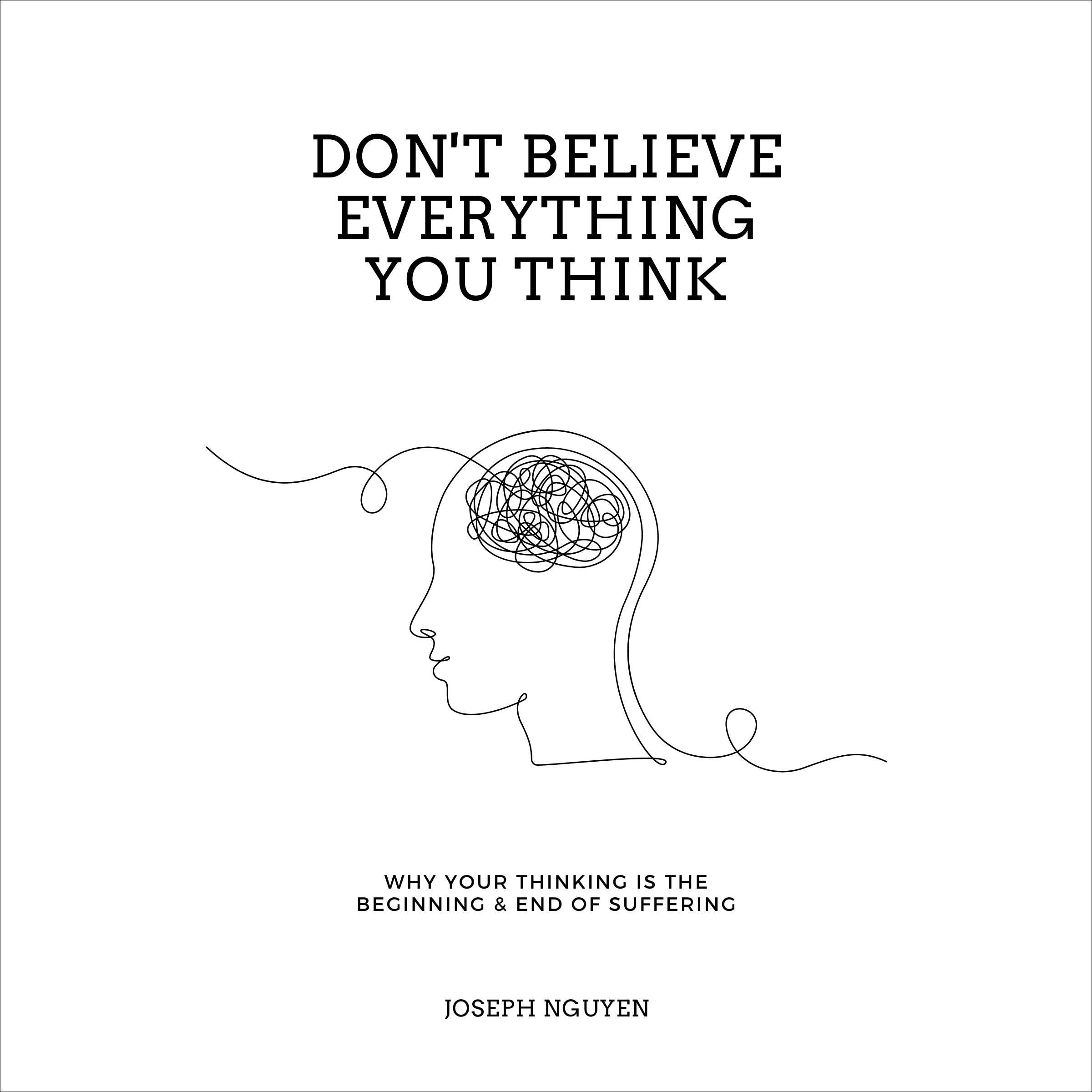
Book cover of Don't Believe Everything You Think

Don't Believe Everything You Think Summary

Meditation & Health

By Joseph Nguyen

Summary

In 'Don't Believe Everything You Think', author Joseph Nguyen delves into the complex world of our thoughts. We often accept our thoughts as absolute truth, but this book challenges that assumption. Nguyen provides a fresh perspective on how our thoughts can shape our reality, both positively and negatively. He shares practical techniques to identify and question the thoughts that hold us back. By learning to distinguish between helpful and unhelpful thoughts, readers can gain greater control over their emotions and actions. The book is filled with real-life stories and actionable advice, making it accessible and engaging. Whether you're struggling with self-doubt, stress, or simply want to improve your mental well-being, this book offers valuable insights and tools. It encourages readers to take charge of their thinking and create a more fulfilling life.

About the Author

Joseph Nguyen is an author well-known for his work "Don't Believe Everything You Think". He specializes in self-help writing. His style is practical and thought-provoking, aiming to guide readers to better understand their thoughts.

Chapters

1

Introduction: The Power of Thought

Our thoughts are incredibly powerful, shaping our perceptions, emotions, and actions. However, we often accept our thoughts as absolute truth without question. "Don't Believe Everything You Think" by Joseph Nguyen challenges this tendency and provides practical strategies to break free from the grip of unhelpful thoughts.In our daily lives, we are bombarded with a constant stream of thoughts. Some of these thoughts are positive and helpful, while others can be negative and self-defeating. For example, we might think "I'm not good enough" or "I'll never succeed." These thoughts can hold us back and prevent us from reaching our full potential.Understanding that our thoughts are not facts is the first step towards taking control of our mental state. By learning to question our thoughts, we can gain greater clarity and make more rational decisions.

2

The Nature of Thoughts

Thoughts are simply mental events that occur in our minds. They are not objective realities but rather interpretations of our experiences. Our thoughts are influenced by our past experiences, beliefs, and cultural background.For instance, if someone had a negative experience in a job interview in the past, they might develop the thought "I'm always going to fail in job interviews." This thought is not based on objective evidence but rather on a single past event.Thoughts can also be automatic. We often have thoughts that pop into our minds without any conscious effort. These automatic thoughts can be very powerful and can have a significant impact on our emotions. For example, an automatic thought like "Everyone hates me" can make us feel sad, angry, or lonely.It's important to recognize that just because we have a thought doesn't mean it's true. We need to develop the ability to step back and observe our thoughts objectively.

3

The Impact of Negative Thoughts

Negative thoughts can have a profound impact on our lives. They can lead to feelings of anxiety, depression, and low self-esteem. When we believe negative thoughts, we are more likely to engage in self-sabotaging behaviors.For example, if we think "I'm too lazy to exercise," we might skip our workout. This can lead to a downward spiral of inactivity and poor health. Negative thoughts can also damage our relationships. If we think "My partner doesn't love me," we might start to act cold or distant, which can actually push our partner away.Moreover, negative thoughts can limit our potential. When we believe we are not capable of achieving something, we are less likely to take the necessary steps to pursue our goals. This can prevent us from growing and evolving as individuals.

4

Cognitive Distortions

Cognitive distortions are patterns of thinking that are inaccurate and often lead to negative emotions. There are several common cognitive distortions that we all experience from time to time.One of the most common cognitive distortions is all-or-nothing thinking. This is when we see things in black and white terms, with no middle ground. For example, we might think "I'm either a complete success or a total failure." This type of thinking can be very limiting and can lead to feelings of disappointment and frustration.Another cognitive distortion is overgeneralization. When we overgeneralize, we take one negative event and apply it to all situations. For instance, if we have one bad date, we might think "I'll never find love." This is an overgeneralization because one bad date does not mean that we will never find a compatible partner.Personalization is also a common cognitive distortion. We personalize when we take responsibility for things that are not entirely our fault. For example, if a friend is in a bad mood, we might think "It's my fault because I did something wrong." In reality, the friend's bad mood could be due to many other factors.

5

Questioning Your Thoughts

To break free from the hold of negative thoughts, we need to learn how to question them. One effective way to do this is by using the Socratic method. This involves asking ourselves a series of questions to challenge the validity of our thoughts.For example, if we have the thought "I'm a failure," we can ask ourselves "What evidence do I have to support this thought?" We might find that the evidence is weak or non-existent. We can also ask "Is there another way to look at this situation?" Maybe we have made some mistakes, but that doesn't mean we are a failure overall.Another useful technique is to look at the consequences of believing a particular thought. If we believe "I'm not good enough," how does this thought make us feel? Does it help us achieve our goals? If the answer is no, then we need to question the thought and find a more positive and realistic alternative.

5 more chapters available

Continue listening in the Spickor app — free download on the App Store.

Listen in App

Why Spickor?

At Spickor, we believe knowledge should have no paywalls. Every book summary can be unlocked for free by watching a short ad — or you can choose an ad-free subscription. Unlike other apps, there's no "1 book per day" free limit. Learn at your own pace, on your own terms.

FeatureSpickorBlinkistHeadway
Free accessAll books free via ad unlock1 book/day only1 book/day only
Book library2,200+ across 8 categories9,000+ (non-fiction only)2,000+ (personal growth focus)
Paid subscriptionNo forced subscription; ad-supportedRequired; from $99.99/yrRequired; from $89.99/yr
Audio for all summariesYesPremium onlyPremium only
Novels & fictionYesNoNo
PlatformsiOS (Android & Web in dev)iOS / Android / WebiOS / Android only

All Books, Truly Free

Unlock any book with a short ad. No daily limits, no hidden fees.

Listen for Free

Every summary includes high-quality audio. No "premium only" labels.

Beyond Self-Help

8 categories including business, technology, and novels.

Listen in App
9 m 06 s