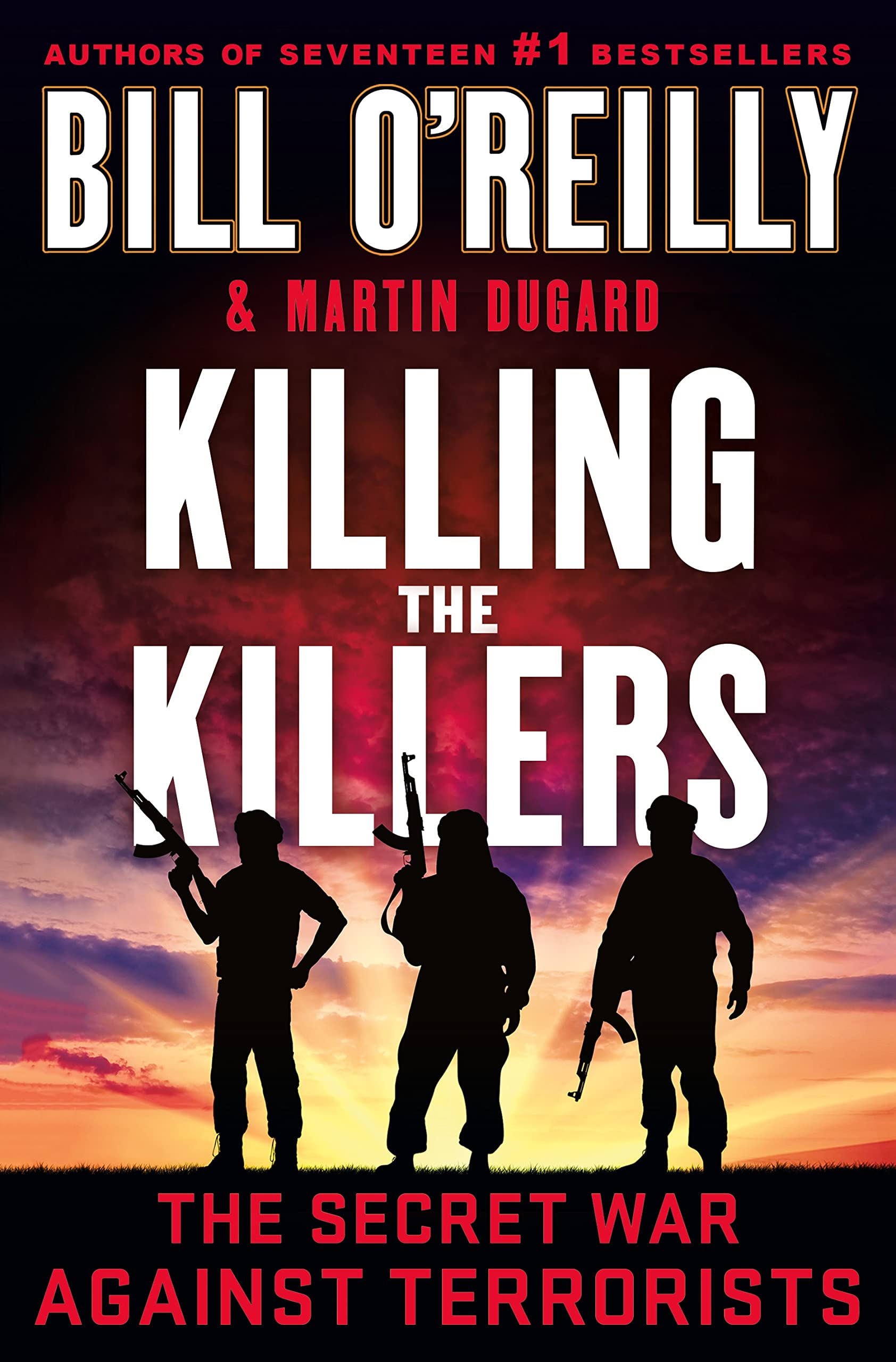
Book cover of Killing the Killers

Killing the Killers Summary

Lifestyle

By Bill O'Reilly

St. Martin's Press · May 3, 2022

Summary

"Killing the Killers" by Bill O'Reilly and Martin Dugard is an enthralling account that delves deep into the lives and actions of the world's most notorious killers. The authors have a talent for weaving together historical facts with gripping narratives. They explore how law-enforcement agencies and military forces have identified, hunted, and neutralized these dangerous individuals. This book is not just about the killers themselves, but also about the heroes who risk their lives to protect society. It offers a unique perspective on the global fight against terrorism and organized crime. As you read, you'll be drawn into a world full of high-stakes operations and intense moments. O'Reilly and Dugard's writing style is accessible, making it easy for readers to follow along, whether you're a history buff or just looking for an exciting read. It's a book that will leave you with a new understanding of the lengths that are taken to keep the world safe.

About the Author

Bill O'Reilly, a well-known journalist, and Martin Dugard, an established writer, co-authored "Killing the Killers". Their writing combines factual details with a compelling narrative style, engaging readers in true-crime and historical accounts.

Chapters

1

Introduction to the Global Threat Landscape

In the modern world, the threat of terrorism looms large, affecting countries across the globe. Terrorist organizations have become increasingly sophisticated, using various means to carry out their attacks and spread fear. The actions of these groups not only cause immediate harm but also have long-term impacts on international relations, economies, and social stability.Terrorist groups operate in different regions, each with its own ideology and goals. Some are focused on religious extremism, aiming to establish a theocratic state based on their interpretation of religious teachings. Others are driven by political grievances, seeking to overthrow existing governments or gain independence for a particular region. These groups often use violence as a tool to achieve their ends, targeting civilians, military installations, and government buildings.The rise of technology has also given terrorists new capabilities. They can use the internet to spread their propaganda, recruit new members, and plan attacks. Social media platforms have become a powerful tool for them to reach a wider audience and radicalize individuals. Additionally, advancements in weapon technology, such as the development of improvised explosive devices (IEDs), have made it easier for terrorists to cause significant damage.The international community has recognized the severity of the terrorist threat and has taken various measures to combat it. This includes intelligence sharing among countries, military operations against terrorist strongholds, and efforts to disrupt terrorist financing. However, the fight against terrorism is a complex and ongoing battle, as terrorists are constantly evolving and finding new ways to operate.


2

The Origins and Ideology of Terrorist Groups

Terrorist groups have diverse origins and ideologies. Many of the well-known groups trace their roots back to historical and political events. For example, some groups in the Middle East emerged in the context of the Israeli-Palestinian conflict. The desire for Palestinian statehood and the perceived injustices in the region have fueled the formation of several terrorist organizations.Religious ideology also plays a significant role in the formation of many terrorist groups. Radical interpretations of Islam have been used to justify violence and terrorist activities. These groups often claim to be fighting for the protection of Islam and the establishment of a pure Islamic state. They believe that their actions are in line with religious teachings, although mainstream Islamic scholars reject these interpretations.In addition to religious and political factors, social and economic conditions can also contribute to the rise of terrorism. Poverty, unemployment, and lack of access to education can create an environment where individuals are more likely to be radicalized. Terrorist groups often target vulnerable populations, offering them a sense of purpose and belonging.The ideology of terrorist groups is often spread through propaganda. They use various media channels, including videos, websites, and social media, to promote their message. This propaganda is designed to recruit new members, justify their actions, and instill fear in their enemies. It often portrays the group as the defenders of a particular cause and demonizes their opponents.

3

High-Profile Terrorist Attacks

Over the years, there have been numerous high-profile terrorist attacks that have had a profound impact on the world. One of the most well-known attacks is the September 11, 2001, attacks in the United States. Al-Qaeda hijacked four commercial airliners and crashed them into the World Trade Center in New York City, the Pentagon in Washington, D.C., and a field in Pennsylvania. The attacks resulted in the deaths of nearly 3,000 people and had a significant impact on global security and international relations.Another major attack was the 2004 Madrid train bombings. A group of terrorists detonated bombs on several commuter trains during the morning rush hour, killing 191 people and injuring hundreds more. This attack was carried out by a local Islamist group with links to international terrorist networks.The 2015 Paris attacks were also a significant event. A series of coordinated attacks took place across Paris, targeting restaurants, a concert hall, and a sports stadium. The attackers, affiliated with the Islamic State (ISIS), killed 130 people and injured hundreds. These attacks highlighted the growing threat of ISIS and its ability to carry out large-scale attacks in Western countries.These high-profile attacks have not only caused immediate loss of life and destruction but have also led to changes in security policies around the world. Governments have increased security measures at airports, public places, and critical infrastructure to prevent future attacks.

4

The Role of Intelligence in Counter-Terrorism

Intelligence plays a crucial role in counter-terrorism efforts. Intelligence agencies around the world work to gather information about terrorist groups, their activities, and their plans. This information is used to prevent attacks, disrupt terrorist networks, and apprehend terrorists.There are different types of intelligence used in counter-terrorism. Human intelligence (HUMINT) involves gathering information from human sources, such as informants and agents. This can provide valuable insights into the inner workings of terrorist groups, including their leadership, recruitment methods, and financial networks.Signals intelligence (SIGINT) involves intercepting and analyzing electronic communications, such as phone calls, emails, and text messages. This can help identify terrorist plots and track the movements of terrorists.Imagery intelligence (IMINT) uses satellite and aerial imagery to monitor terrorist training camps, hideouts, and other areas of interest. This can provide information about the size and location of terrorist groups and their activities.Intelligence agencies also work together through international cooperation. They share information and coordinate their efforts to combat terrorism on a global scale. However, intelligence gathering is not without challenges. Terrorist groups are constantly trying to evade detection, and there are legal and ethical issues associated with intelligence collection.

5

Military Operations Against Terrorist Groups

Military operations are an important part of the fight against terrorism. Governments around the world have launched military campaigns to target terrorist strongholds and disrupt their operations. These operations can take various forms, including air strikes, ground invasions, and special forces operations.One of the most well-known military operations against terrorism was the United States' invasion of Afghanistan in 2001. After the September 11 attacks, the U.S. government launched a military campaign to remove the Taliban regime, which had provided a safe haven for Al-Qaeda. The operation involved a large-scale military deployment, including air strikes and ground troops.Another example is the military operations against ISIS in Iraq and Syria. A coalition of countries, led by the United States, carried out air strikes and ground operations to defeat ISIS and reclaim territory that had been occupied by the group. These operations have been successful in reducing the territorial control of ISIS and weakening its military capabilities.However, military operations also have their challenges. They can cause civilian casualties and damage to infrastructure. There is also the risk of creating a cycle of violence, as military actions can lead to increased radicalization and recruitment by terrorist groups. Additionally, military operations need to be carefully planned and coordinated to ensure their effectiveness.

5 more chapters available

Continue listening in the Spickor app — free download on the App Store.

Listen in App

Why Spickor?

At Spickor, we believe knowledge should have no paywalls. Every book summary can be unlocked for free by watching a short ad — or you can choose an ad-free subscription. Unlike other apps, there's no "1 book per day" free limit. Learn at your own pace, on your own terms.

FeatureSpickorBlinkistHeadway
Free accessAll books free via ad unlock1 book/day only1 book/day only
Book library2,200+ across 8 categories9,000+ (non-fiction only)2,000+ (personal growth focus)
Paid subscriptionNo forced subscription; ad-supportedRequired; from $99.99/yrRequired; from $89.99/yr
Audio for all summariesYesPremium onlyPremium only
Novels & fictionYesNoNo
PlatformsiOS (Android & Web in dev)iOS / Android / WebiOS / Android only

All Books, Truly Free

Unlock any book with a short ad. No daily limits, no hidden fees.

Listen for Free

Every summary includes high-quality audio. No "premium only" labels.

Beyond Self-Help

8 categories including business, technology, and novels.

Listen in App
14 m 54 s