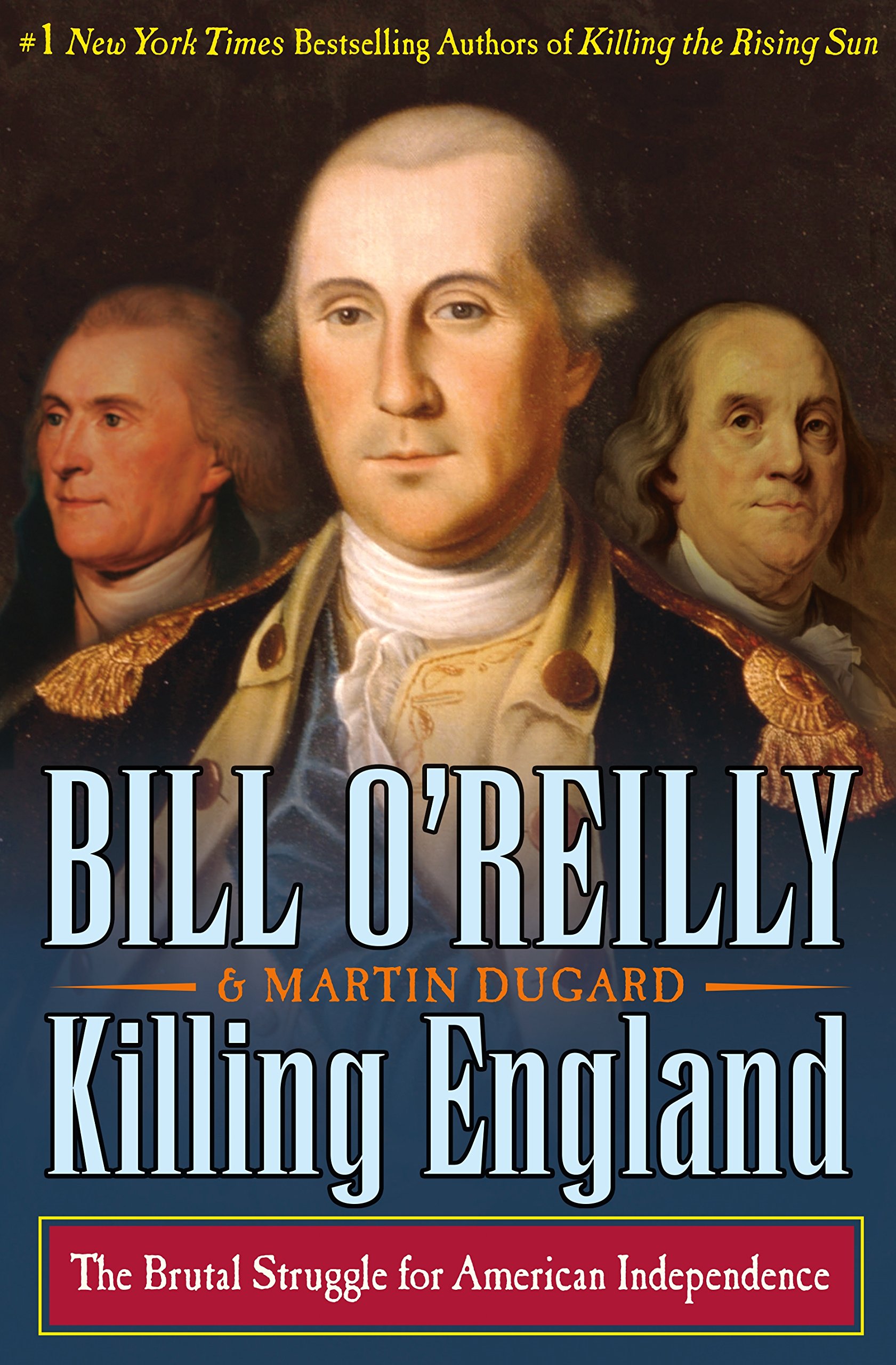
Book cover of Killing England

Killing England Summary

Humanity & Culture

By Bill O'Reilly

Henry Holt and Co. · September 19, 2017

Summary

"Killing England" by Bill O'Reilly and Martin Dugard is an enthralling historical narrative that delves deep into the pivotal era of America's fight for independence from British rule. The authors skillfully weave together a rich tapestry of events, from the political unrest in the colonies to the military campaigns that would ultimately decide the fate of a new nation. Through their detailed research and engaging writing style, they bring to life the key figures of the time, including George Washington, King George III, and many others. The book not only provides a comprehensive account of the historical events but also offers insights into the human emotions, motivations, and sacrifices of those involved. It's a story of courage, determination, and the pursuit of freedom, set against the backdrop of a nation in the making. Whether you're a history buff or just looking for an exciting and educational read, "Killing England" is sure to keep you engaged from start to finish.

About the Author

Bill O'Reilly, a well-known journalist, and Martin Dugard, an author, co-wrote "Killing England". Their writing in historical narrative combines vivid storytelling with in-depth research, presenting history in an engaging way.

Chapters

1

Introduction to the Revolutionary Context

The story unfolds against the backdrop of the late 18th-century Anglo-American relationship. At that time, the British Empire was a global superpower, with far-reaching colonies around the world. The American colonies, on the other hand, had been steadily growing in population and economic strength. The British government imposed a series of taxes on the American colonies, such as the Stamp Act in 1765, which required colonists to pay a tax on printed materials. This was met with strong resistance from the colonists. They argued that they had no representation in the British Parliament, so they shouldn't be taxed. The slogan "No taxation without representation" became a rallying cry for the colonists. The colonists formed various groups to oppose British rule. The Sons of Liberty, for example, was a secret organization that carried out acts of protest against British policies. They organized boycotts of British goods, which had a significant impact on the British economy. As the tension between the colonies and Britain escalated, it set the stage for a full-scale conflict. The British government tried to assert its authority over the colonies. They sent troops to maintain order, which only further angered the colonists. The presence of British soldiers in the colonies led to numerous skirmishes and incidents. One of the most notable was the Boston Massacre in 1770, where British soldiers opened fire on a crowd of colonists, killing five people. This event was widely publicized in the colonies and further inflamed anti-British sentiment. The colonists began to see themselves as a distinct entity, separate from Britain. They started to develop a sense of American identity, which was a crucial factor in the lead-up to the revolution. This growing sense of identity, combined with the economic and political grievances, made a break from Britain seem inevitable.


2

The Road to Revolution

The First Continental Congress was a significant event in the lead-up to the revolution. In 1774, representatives from twelve of the thirteen colonies met in Philadelphia. They discussed the situation with Britain and decided to form a united front against British policies. They called for a boycott of British goods and demanded that the British government repeal the Intolerable Acts, which were a series of punitive measures imposed on the colonies after the Boston Tea Party. The Boston Tea Party in 1773 was a bold act of protest. A group of colonists, dressed as Native Americans, boarded British ships in Boston Harbor and dumped 342 chests of tea into the water. This was a direct response to the Tea Act, which gave the British East India Company a monopoly on the tea trade in the colonies. The British government was furious and responded with the Intolerable Acts, which included closing the port of Boston and increasing the power of the British governor in Massachusetts. As the situation deteriorated, the colonists began to prepare for war. They formed local militias, which were groups of citizen-soldiers. These militias trained regularly and stockpiled weapons and ammunition. The British, on the other hand, also started to take military action. In April 1775, British troops were sent to Concord to seize a cache of colonial weapons. This led to the battles of Lexington and Concord, which are often considered the first battles of the American Revolution. The battles at Lexington and Concord were a wake-up call for both sides. The colonists showed that they were willing to fight for their rights, and the British realized that the situation in the colonies was more serious than they had thought. The news of these battles spread quickly throughout the colonies, and more and more people joined the cause of independence.

3

The Declaration of Independence

The Second Continental Congress, which met in 1775, took on the task of leading the colonies during the war. They appointed George Washington as the commander-in-chief of the Continental Army. Washington was a respected military leader with experience from the French and Indian War. In 1776, the Continental Congress decided to declare independence from Britain. A committee was formed to draft the Declaration of Independence, with Thomas Jefferson as the primary author. The Declaration of Independence was a powerful statement of the colonists' beliefs and grievances. It declared that all men are created equal and have certain unalienable rights, such as life, liberty, and the pursuit of happiness. The document also listed a long list of grievances against the British king, George III. It accused him of tyranny, such as imposing taxes without consent, quartering troops in private homes, and dissolving colonial legislatures. The Declaration of Independence was adopted on July 4, 1776, and it marked a turning point in the American Revolution. It gave the colonists a clear goal: to establish an independent nation. The Declaration had a profound impact both within the colonies and around the world. It inspired other countries to fight for their own independence and became a symbol of freedom and democracy. It also united the colonists in their struggle against Britain, as they now had a common cause to fight for.

4

The Early Stages of the War

The early stages of the American Revolution were challenging for the Continental Army. The British had a well-trained and well-equipped military, while the Continental Army was made up of mostly inexperienced volunteers. The British launched a series of military campaigns in the northern colonies. They captured New York City in 1776, which was a major blow to the Americans. The Continental Army was forced to retreat, and morale was low. However, George Washington was determined to turn the situation around. One of the key battles in the early stages was the Battle of Trenton. On Christmas night in 1776, Washington led his troops across the Delaware River and launched a surprise attack on the Hessian mercenaries stationed in Trenton. The Americans were victorious, which boosted morale and showed that they could compete with the British. Another important battle was the Battle of Saratoga in 1777. The British planned to divide the colonies by capturing the Hudson River Valley. However, the American forces under General Horatio Gates were able to surround and defeat the British army at Saratoga. This victory was a turning point in the war. It convinced the French to ally with the Americans, which provided much-needed military and financial support. The French alliance was a game-changer. The French provided the Americans with ships, weapons, and troops. They also helped to blockade the British ports, which cut off the British supply lines. This support was crucial in the Americans' ability to continue the fight against the British.

5

The Southern Campaigns

After the defeat at Saratoga, the British shifted their focus to the southern colonies. They believed that there were more loyalists in the South who would support the British cause. The British launched a series of campaigns in the South, starting with the capture of Savannah, Georgia, in 1778. They then moved on to Charleston, South Carolina, which fell in 1780. The British seemed to be making significant progress in the South. However, the Americans in the South were not easily defeated. They used guerrilla warfare tactics, which were highly effective against the British. Leaders like Francis Marion, known as the "Swamp Fox," led small bands of soldiers who harassed the British troops, raiding their supply lines and ambushing them in the swamps. The Battle of Cowpens in 1781 was a major victory for the Americans. General Daniel Morgan led the American forces to a decisive victory over the British. This victory weakened the British position in the South and forced them to retreat. The British then moved their forces to Yorktown, Virginia. They hoped to establish a base there and receive reinforcements from the British navy. However, the combined forces of the American and French armies surrounded the British at Yorktown.

5 more chapters available

Continue listening in the Spickor app — free download on the App Store.

Listen in App

Why Spickor?

At Spickor, we believe knowledge should have no paywalls. Every book summary can be unlocked for free by watching a short ad — or you can choose an ad-free subscription. Unlike other apps, there's no "1 book per day" free limit. Learn at your own pace, on your own terms.

FeatureSpickorBlinkistHeadway
Free accessAll books free via ad unlock1 book/day only1 book/day only
Book library2,200+ across 8 categories9,000+ (non-fiction only)2,000+ (personal growth focus)
Paid subscriptionNo forced subscription; ad-supportedRequired; from $99.99/yrRequired; from $89.99/yr
Audio for all summariesYesPremium onlyPremium only
Novels & fictionYesNoNo
PlatformsiOS (Android & Web in dev)iOS / Android / WebiOS / Android only

All Books, Truly Free

Unlock any book with a short ad. No daily limits, no hidden fees.

Listen for Free

Every summary includes high-quality audio. No "premium only" labels.

Beyond Self-Help

8 categories including business, technology, and novels.

Listen in App
13 m 55 s