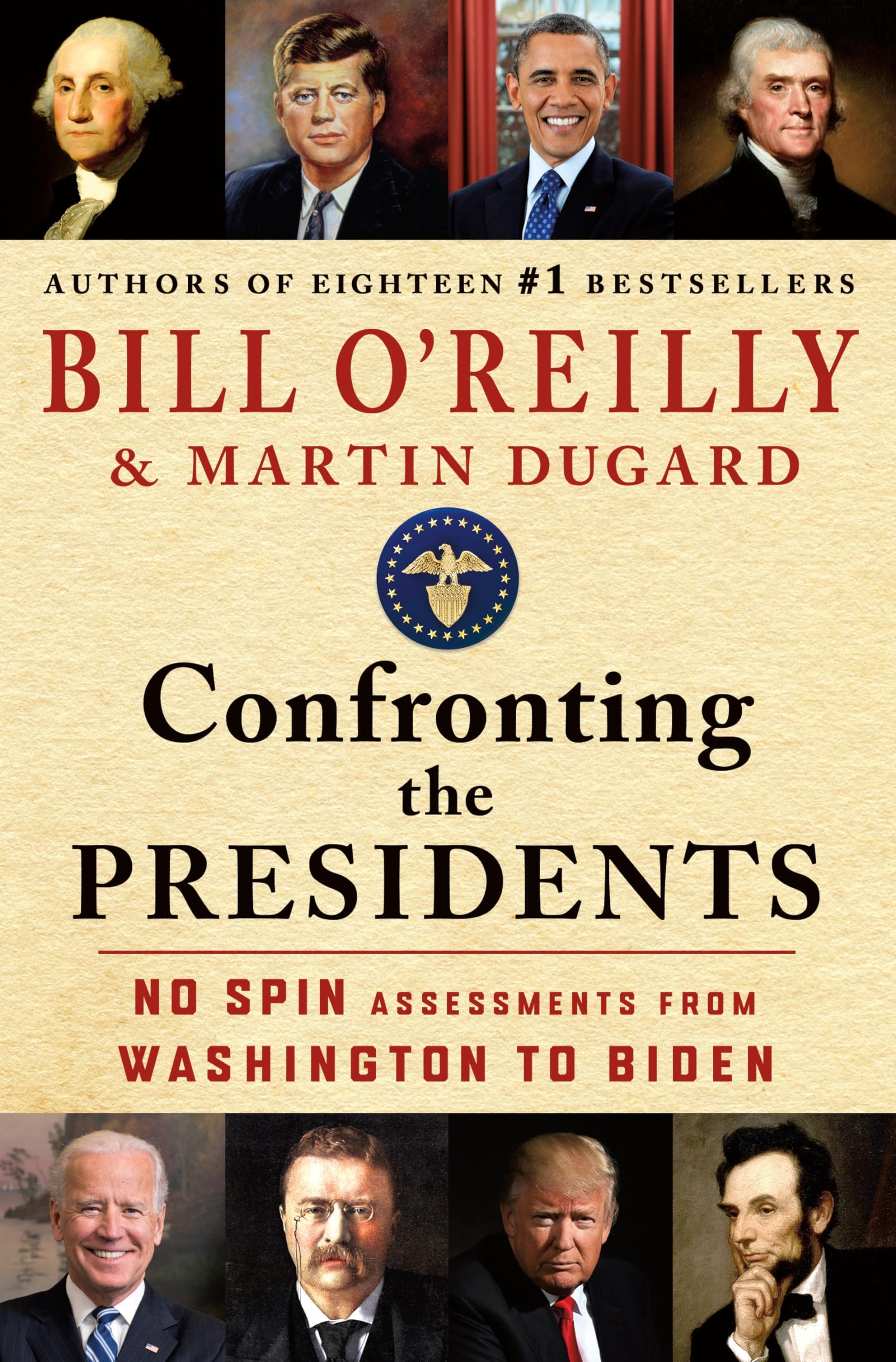
Book cover of Confronting the Presidents

Confronting the Presidents Summary

Humanity & Culture

By Bill O'Reilly

St. Martin's Press · September 10, 2024

Summary

Confronting the Presidents, penned by Bill O'Reilly and Martin Dugard, is a captivating exploration of the United States' presidents. The book delves into the lives of these leaders, from their early days to their time in the Oval Office. It uncovers the struggles, triumphs, and pivotal moments that shaped their presidencies. Through meticulous research and engaging storytelling, the authors present a balanced view of these historical figures. Whether it's the political maneuvering, the social issues of the time, or the personal challenges they faced, this book provides a comprehensive look at what it means to be the leader of a nation. It's not just a history book; it's a window into the human side of the presidents. Readers will find themselves drawn into the world of American politics and history, gaining a deeper understanding of the country's past and the men who have led it.

About the Author

Bill O'Reilly, a well-known political commentator, and Martin Dugard, an experienced writer, co-authored "Confronting the Presidents". Their writing combines historical facts with engaging storytelling, presenting a vivid and thought-provoking account.

Chapters

1

Introduction

"Confronting the Presidents" by Bill O'Reilly and Martin Dugard is an engaging exploration of the United States' history through the lens of significant confrontations faced by its presidents. This book takes readers on a journey from the early days of the nation to more recent times, highlighting how presidents dealt with various challenges, both domestic and international. These confrontations have not only shaped the presidencies but also had a profound impact on the course of American history. By examining these critical moments, we can gain a deeper understanding of the leadership qualities, decision-making processes, and the political and social context of each era.

2

Early Presidential Confrontations

In the early days of the United States, presidents faced unique challenges as they tried to establish a stable nation. George Washington, the first president, had to deal with the issue of national debt. The young nation was burdened with debts from the Revolutionary War, and Washington had to find a way to manage and pay them off. He worked with Alexander Hamilton to develop a financial plan that included the assumption of state debts by the federal government and the establishment of a national bank. This plan was not without controversy, as some states opposed the idea of having their debts taken over by the federal government.Another early confrontation was the Whiskey Rebellion. Farmers in western Pennsylvania were angry about a tax on whiskey, which was a major source of income for them. They resisted the tax and even engaged in violent protests. Washington decided to take a strong stand and led a military force to suppress the rebellion. This showed that the federal government was willing to enforce its laws and maintain order.John Adams, the second president, faced the challenge of maintaining neutrality in the ongoing conflict between France and Britain. The French were angry at the United States for its perceived support of Britain, and this led to the XYZ Affair. French agents demanded bribes from American diplomats, which caused a public outcry in the United States. Adams decided to build up the navy and prepare for war, but he also tried to negotiate a peaceful solution. Eventually, a treaty was signed, avoiding a full-scale war.

3

Jacksonian Era Confrontations

Andrew Jackson's presidency was marked by several significant confrontations. One of the most notable was the Nullification Crisis. South Carolina declared that it had the right to nullify federal laws that it considered unconstitutional, specifically a tariff law. Jackson firmly believed in the power of the federal government and threatened to use military force to enforce the law. He also proposed a compromise tariff to ease the situation. This crisis tested the balance of power between the states and the federal government.Jackson also had a major confrontation with the Second Bank of the United States. He believed that the bank was a tool of the wealthy and had too much power. He vetoed the recharter of the bank, which led to a long-term battle. The bank's supporters, including Henry Clay, tried to use the issue against Jackson in the 1832 presidential election, but Jackson was re-elected. The destruction of the bank had far-reaching consequences for the nation's financial system.

4

Civil War and Reconstruction Confrontations

The issue of slavery was the central confrontation leading up to the Civil War. Abraham Lincoln, who was elected in 1860, opposed the expansion of slavery into new territories. His election was a major factor that led to the secession of several southern states. The Confederacy was formed, and the Civil War began.Lincoln faced the difficult task of leading the nation through the war. He issued the Emancipation Proclamation, which declared slaves in Confederate-held territory to be free. This was a significant step towards ending slavery. After the war, the process of Reconstruction began. Lincoln's plan for Reconstruction was relatively lenient, aiming to quickly reunite the nation. However, his assassination in 1865 changed the course of Reconstruction. Andrew Johnson, who succeeded Lincoln, had a different approach. He clashed with Congress over Reconstruction policies, and Congress eventually impeached him, although he was not removed from office.

5

Industrialization and Progressive Era Confrontations

During the late 19th and early 20th centuries, the United States was undergoing rapid industrialization. Presidents of this era faced the challenge of regulating big business. Theodore Roosevelt, for example, was known as a "trust-buster." He used the Sherman Antitrust Act to break up large monopolies, such as the Standard Oil Company. This was an attempt to promote competition and protect consumers.The Progressive Era also saw a push for social reforms. Presidents like Woodrow Wilson supported measures such as the establishment of the Federal Reserve System to regulate the nation's monetary policy. He also promoted labor reforms, including the eight-hour workday and better working conditions. However, Wilson also faced challenges in foreign policy, especially during World War I. He initially tried to keep the United States neutral but eventually decided to enter the war in 1917.

5 more chapters available

Continue listening in the Spickor app — free download on the App Store.

Listen in App

Why Spickor?

At Spickor, we believe knowledge should have no paywalls. Every book summary can be unlocked for free by watching a short ad — or you can choose an ad-free subscription. Unlike other apps, there's no "1 book per day" free limit. Learn at your own pace, on your own terms.

FeatureSpickorBlinkistHeadway
Free accessAll books free via ad unlock1 book/day only1 book/day only
Book library2,200+ across 8 categories9,000+ (non-fiction only)2,000+ (personal growth focus)
Paid subscriptionNo forced subscription; ad-supportedRequired; from $99.99/yrRequired; from $89.99/yr
Audio for all summariesYesPremium onlyPremium only
Novels & fictionYesNoNo
PlatformsiOS (Android & Web in dev)iOS / Android / WebiOS / Android only

All Books, Truly Free

Unlock any book with a short ad. No daily limits, no hidden fees.

Listen for Free

Every summary includes high-quality audio. No "premium only" labels.

Beyond Self-Help

8 categories including business, technology, and novels.

Listen in App
11 m 08 s