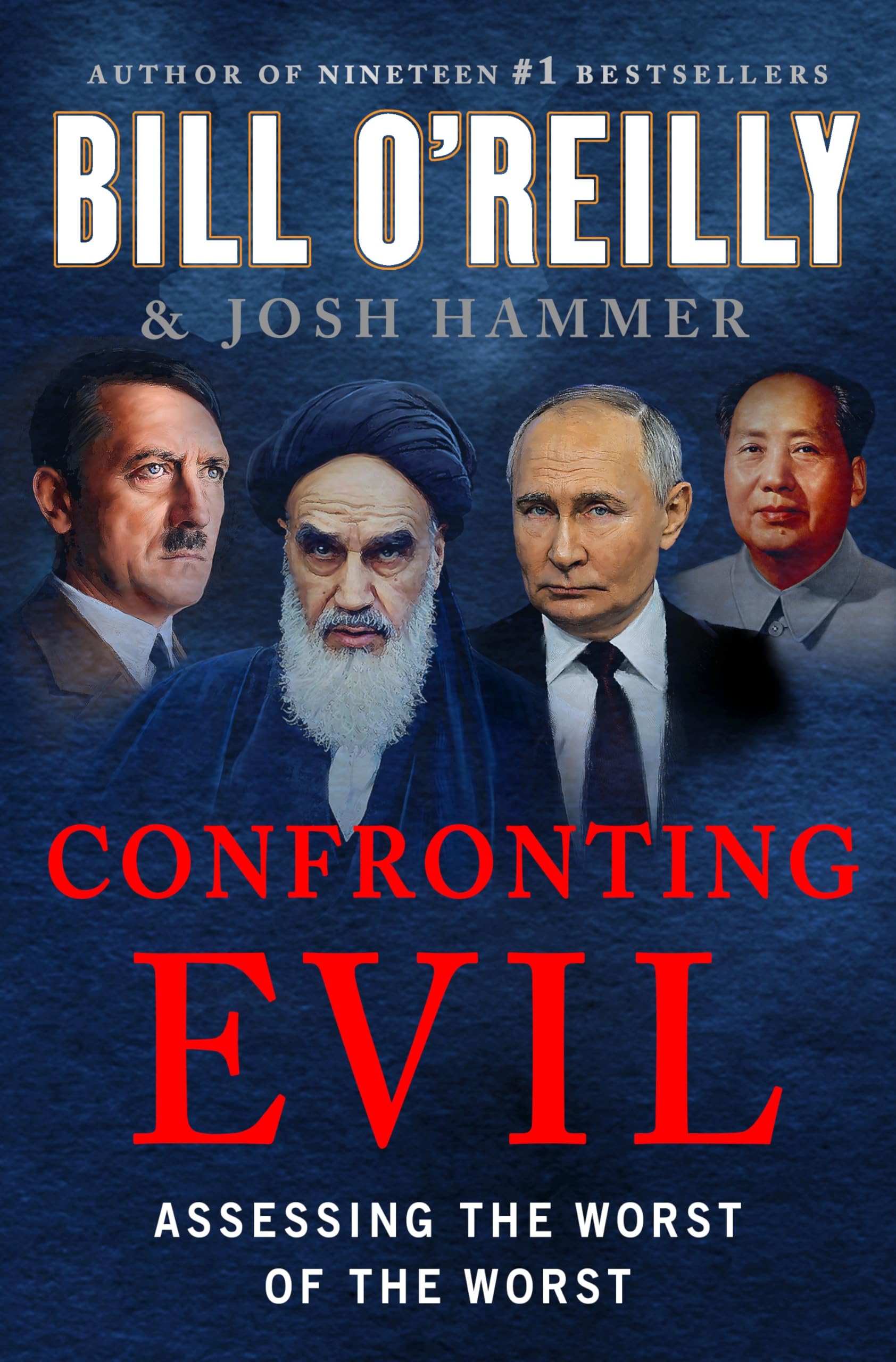
Book cover of Confronting Evil

Confronting Evil Summary

Humanity & Culture

By Bill O'Reilly

St. Martin's Press · September 9, 2025

Summary

Confronting Evil, penned by Bill O'Reilly and Josh Hammer, is a captivating exploration of the concept of evil in our world. The authors, with their combined expertise and experience, embark on a journey to understand the roots and manifestations of evil. They examine historical events, contemporary issues, and the human psyche to shed light on how evil operates. The book doesn't shy away from difficult questions, such as why some individuals choose the path of malevolence and how society can respond. It offers a multi-faceted view, drawing on real-life examples and in-depth analysis. Whether it's the evil deeds of dictators or the small-scale acts of immorality, Confronting Evil provides a comprehensive look at the topic. It's a must-read for those who want to gain a better understanding of the darker side of humanity and how to stand up against it.

About the Author

Bill O'Reilly and Josh Hammer are well-known authors. They focus on writing about social and political issues. Their style in "Confronting Evil" is direct and incisive, presenting strong viewpoints.

Chapters

1

Introduction: The Imperative of Confronting Evil

In a world fraught with complexity and moral ambiguity, the need to confront evil is more pressing than ever. Evil is not an abstract concept but a tangible force that manifests in various forms, from individual acts of violence to systemic injustices. This book delves into the nature of evil, its historical manifestations, and the moral imperative for individuals and societies to stand against it.Evil can be defined as the deliberate and unjust infliction of harm, whether physical, emotional, or psychological. It often stems from a combination of factors, including greed, hatred, and a disregard for the well-being of others. Throughout history, evil has taken many guises, from the atrocities of war to the oppression of marginalized groups.The consequences of failing to confront evil are far-reaching. It can lead to the erosion of social values, the breakdown of communities, and the perpetuation of suffering. Therefore, understanding and combating evil is not only a moral obligation but also essential for the survival and flourishing of humanity.


2

The Historical Landscape of Evil

Throughout history, evil has left a dark mark on human civilization. From the ancient empires that engaged in slavery and conquest to the modern-day genocides, the story of humanity is intertwined with acts of great evil.In the ancient world, empires like the Roman Empire and the Assyrian Empire were known for their brutal conquests and the subjugation of other peoples. Slavery was widespread, and the lives of the enslaved were often filled with misery and exploitation. The Roman gladiatorial games, where slaves and prisoners were forced to fight to the death for the entertainment of the masses, are a prime example of the callousness and cruelty of the time.During the Middle Ages, the Inquisition was a period of great evil. The Catholic Church, in an attempt to root out heresy, used torture and persecution to silence those who disagreed with its teachings. Thousands of people were burned at the stake, imprisoned, or tortured in the name of religious orthodoxy.The 20th century witnessed some of the most heinous acts of evil in human history. The Holocaust, perpetrated by the Nazis, resulted in the systematic murder of six million Jews, along with millions of other victims, including Roma, homosexuals, and the disabled. The Rwandan Genocide in 1994 saw the mass killing of an estimated 800,000 Tutsis by Hutu extremists in just 100 days.These historical examples serve as a reminder of the capacity of humans to commit great evil and the importance of learning from the past to prevent similar atrocities in the future.

3

The Psychology of Evil

Understanding the psychology of evil is crucial in the fight against it. Evil is not simply the result of a few "bad apples" but can be influenced by a variety of psychological factors.One of the key factors is dehumanization. When people view others as less than human, it becomes easier to justify harming them. This can be seen in situations where groups are labeled as "enemies," "animals," or "sub-human." For example, during the Holocaust, the Nazis dehumanized the Jews by referring to them as "vermin" and "parasites," which made it easier for them to carry out the mass extermination.Another psychological factor is the diffusion of responsibility. In group settings, individuals may feel less accountable for their actions because they believe that others are also responsible. This can lead to a situation where people participate in evil acts without fully realizing the consequences. The Milgram experiment, where participants were willing to administer what they believed were dangerous electric shocks to others under the instructions of an authority figure, is a classic example of the diffusion of responsibility.Cognitive dissonance also plays a role in the psychology of evil. When people engage in actions that conflict with their moral beliefs, they may try to reduce the dissonance by justifying their actions. For example, a soldier who is ordered to kill civilians may convince himself that it is necessary for the greater good, even if it goes against his own moral code.

4

Evil in the Modern World

In the modern world, evil takes on new forms. While traditional forms of evil such as war and violence still exist, there are also emerging threats that pose significant challenges.Terrorism is one of the most prominent forms of evil in the modern era. Terrorist groups use violence and intimidation to achieve their political or ideological goals. They target innocent civilians, causing widespread fear and destruction. For example, the 9/11 attacks in the United States were carried out by the terrorist group Al-Qaeda, resulting in the deaths of nearly 3,000 people.Cyber-crime is another growing form of evil. Hackers can steal personal information, disrupt critical infrastructure, and spread malware. The anonymity provided by the internet makes it easier for criminals to carry out their activities without being detected. For instance, ransomware attacks have become increasingly common, where hackers encrypt a victim's data and demand a ransom for its release.Social media has also been a breeding ground for evil. It can be used to spread misinformation, hate speech, and incite violence. The spread of false news and conspiracy theories on social media platforms can have real-world consequences, such as the erosion of trust in institutions and the polarization of society.

5

The Role of Individuals in Confronting Evil

Individuals have a crucial role to play in the fight against evil. Each person has the power to make a difference, whether it is through small acts of kindness or by taking a stand against injustice.One of the first steps is to develop moral courage. This means having the strength to do what is right, even in the face of adversity. For example, during the civil rights movement in the United States, individuals like Rosa Parks and Martin Luther King Jr. showed great moral courage by standing up against racial segregation.Education is also essential. By learning about the history of evil and the factors that contribute to it, individuals can become more aware of the signs of evil and be better prepared to take action. This includes teaching critical thinking skills, so that people can evaluate information and make informed decisions.In addition, individuals can use their voices to speak out against evil. This can involve writing letters to elected officials, participating in peaceful protests, or using social media to raise awareness about important issues. By working together, individuals can create a groundswell of support for positive change.

5 more chapters available

Continue listening in the Spickor app — free download on the App Store.

Listen in App

Why Spickor?

At Spickor, we believe knowledge should have no paywalls. Every book summary can be unlocked for free by watching a short ad — or you can choose an ad-free subscription. Unlike other apps, there's no "1 book per day" free limit. Learn at your own pace, on your own terms.

FeatureSpickorBlinkistHeadway
Free accessAll books free via ad unlock1 book/day only1 book/day only
Book library2,200+ across 8 categories9,000+ (non-fiction only)2,000+ (personal growth focus)
Paid subscriptionNo forced subscription; ad-supportedRequired; from $99.99/yrRequired; from $89.99/yr
Audio for all summariesYesPremium onlyPremium only
Novels & fictionYesNoNo
PlatformsiOS (Android & Web in dev)iOS / Android / WebiOS / Android only

All Books, Truly Free

Unlock any book with a short ad. No daily limits, no hidden fees.

Listen for Free

Every summary includes high-quality audio. No "premium only" labels.

Beyond Self-Help

8 categories including business, technology, and novels.

Listen in App
12 m 30 s