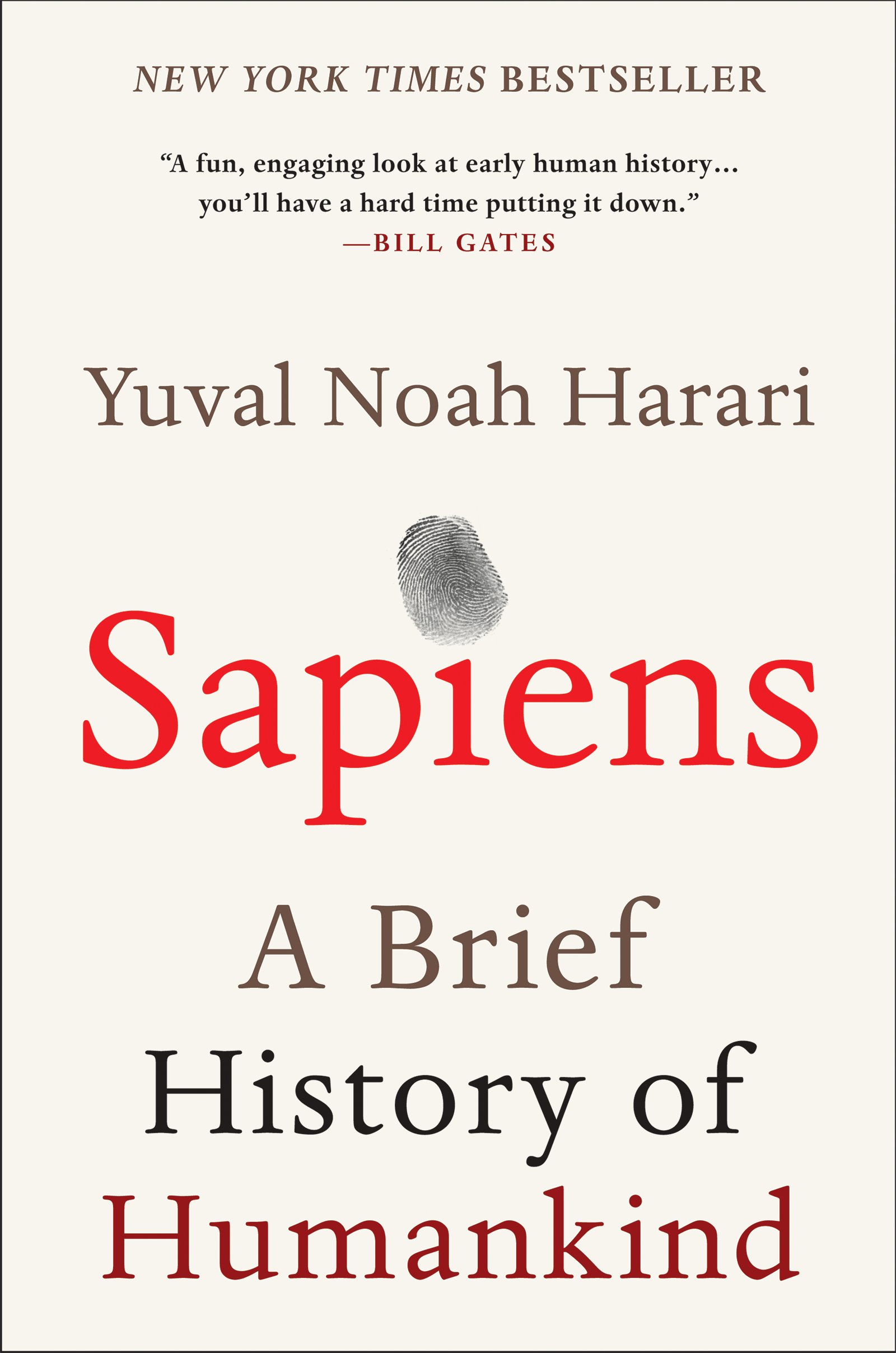
Book cover of Sapiens

Sapiens Summary

Humanity & Culture

By Yuval Noah Harari

Harper · February 10, 2015

Summary

Sapiens, written by Yuval Noah Harari, is a remarkable exploration of the history of Homo sapiens. The book starts from the very beginning, when humans were just another species of animals, and traces our evolution through different stages. Harari delves into how we developed unique cognitive abilities, such as the power of imagination and language, which allowed us to form large-scale cooperation and create complex societies. He also examines the impact of key events like the Agricultural Revolution and the Scientific Revolution on human civilization. Through vivid descriptions and thought-provoking analysis, Sapiens not only provides a comprehensive overview of human history but also makes us reflect on our place in the world and our future. It is a well-written and accessible book that bridges the gap between academic research and popular knowledge.

About the Author

Yuval Noah Harari is a renowned Israeli historian. He specializes in writing about human history and future trends. His style is engaging, combining profound insights with accessible language, as seen in his best-seller "Sapiens".

Chapters

1

Introduction to *Sapiens: A Brief History of Humankind*

*Sapiens: A Brief History of Humankind* by Yuval Noah Harari offers a comprehensive and thought-provoking overview of the history of Homo sapiens from their emergence to the present day. This book takes readers on a journey through different stages of human development, exploring how humans became the dominant species on Earth.


2

The Cognitive Revolution

The story begins with the Cognitive Revolution, which occurred around 70,000 years ago. Before this revolution, humans were just another species of animals, living in small groups and struggling to survive. However, a significant change in the human brain allowed for the development of language. This new form of communication was not just about sharing basic information like the location of food or danger; it enabled humans to create and share fictional stories.These fictional stories, such as myths and religions, were the key to human cooperation on a large scale. They allowed strangers to work together towards a common goal. For example, a group of people could believe in the same god or a shared ideology, which would bind them together. This ability to cooperate in large numbers gave humans a huge advantage over other species. With this new-found cooperation, humans were able to hunt more effectively, build complex shelters, and develop new technologies. As a result, they spread across the globe, outcompeting other human species like the Neanderthals.

3

The Agricultural Revolution

Around 10,000 years ago, humans experienced the Agricultural Revolution. This was a major turning point in human history as people shifted from a hunter-gatherer lifestyle to farming. The transition to agriculture was not a sudden event but a gradual process. People began to plant crops like wheat, barley, and rice, and domesticate animals such as cows, sheep, and pigs.Agriculture allowed humans to produce a surplus of food, which in turn supported larger populations. With more food available, people could settle in one place and build permanent settlements. These settlements grew into villages, towns, and eventually cities. However, the Agricultural Revolution also had its drawbacks. Farming was often more labor-intensive than hunting and gathering, and people became more vulnerable to crop failures and diseases. Despite these challenges, the growth of agriculture led to the development of more complex social structures. There was a division of labor, with some people becoming farmers, others artisans, and some taking on leadership roles. This division of labor was the foundation for the development of civilizations.

4

The Emergence of Civilizations

As human settlements grew and became more complex, civilizations began to emerge. Civilizations are characterized by large-scale social organization, the development of writing systems, and the creation of art and architecture. One of the earliest civilizations was the Sumerian civilization in Mesopotamia. The Sumerians developed a writing system called cuneiform, which was used for record-keeping, literature, and religious texts.With the development of writing, knowledge could be stored and passed down through generations. This allowed for the accumulation of knowledge in various fields such as mathematics, astronomy, and medicine. Different civilizations also had their own unique cultures, religions, and political systems. For example, the Egyptians built massive pyramids as tombs for their pharaohs, which were not only architectural marvels but also symbols of their religious beliefs and social hierarchy. The Greeks, on the other hand, made significant contributions to philosophy, democracy, and science. Their ideas and achievements had a profound influence on Western civilization.

5

The Unification of Humankind

Over time, humans began to interact with each other on a larger scale, leading to the unification of humankind. This process was driven by various factors, including trade, conquest, and the spread of religions. Trade routes, such as the Silk Road, connected different parts of the world, allowing for the exchange of goods, ideas, and technologies. For example, Chinese silk was highly sought after in the Roman Empire, and in return, the Chinese received goods like glass and precious metals from the West.Conquest also played a role in unifying different regions. Empires such as the Roman Empire and the Mongol Empire expanded their territories, bringing different cultures and peoples under one rule. These empires often imposed a common language, laws, and administrative systems, which helped to integrate diverse populations. Religions like Christianity, Islam, and Buddhism also spread across the globe, providing a common set of beliefs and values for millions of people. These religions not only influenced people's spiritual lives but also had an impact on politics, art, and social norms.

5 more chapters available

Continue listening in the Spickor app — free download on the App Store.

Listen in App

Why Spickor?

At Spickor, we believe knowledge should have no paywalls. Every book summary can be unlocked for free by watching a short ad — or you can choose an ad-free subscription. Unlike other apps, there's no "1 book per day" free limit. Learn at your own pace, on your own terms.

FeatureSpickorBlinkistHeadway
Free accessAll books free via ad unlock1 book/day only1 book/day only
Book library2,200+ across 8 categories9,000+ (non-fiction only)2,000+ (personal growth focus)
Paid subscriptionNo forced subscription; ad-supportedRequired; from $99.99/yrRequired; from $89.99/yr
Audio for all summariesYesPremium onlyPremium only
Novels & fictionYesNoNo
PlatformsiOS (Android & Web in dev)iOS / Android / WebiOS / Android only

All Books, Truly Free

Unlock any book with a short ad. No daily limits, no hidden fees.

Listen for Free

Every summary includes high-quality audio. No "premium only" labels.

Beyond Self-Help

8 categories including business, technology, and novels.

Listen in App
10 m 58 s