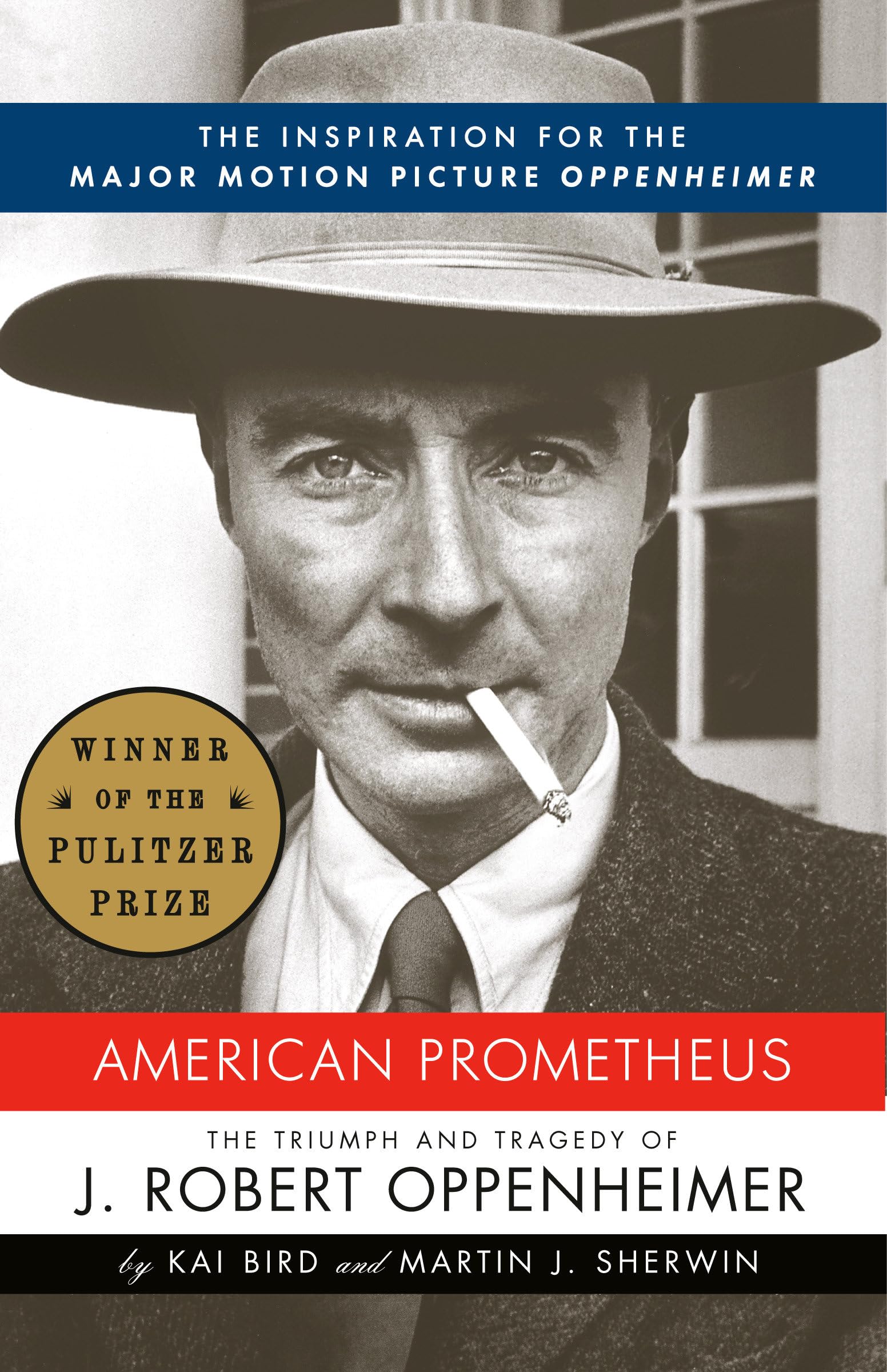
Book cover of American Prometheus

American Prometheus Summary

Humanity & Culture

By Martin J. Sherwin

Vintage Books · May 1, 2006

Summary

American Prometheus, penned by Kai Bird and Martin J. Sherwin, is a captivating exploration of a key American figure. The book takes readers on a journey through the life of this individual, from their early days to their most influential moments. The authors draw on extensive research, including previously unpublished materials, to present a comprehensive and nuanced portrait. As the narrative unfolds, readers will discover the complex web of relationships, decisions, and events that shaped the subject's life. It offers a unique perspective on American history, highlighting the role of this figure in significant events. Whether you're a history buff or simply curious about the human stories behind historical events, American Prometheus is sure to engage and inform.

About the Author

Kai Bird and Martin J. Sherwin are well-known authors. They focus on historical non-fiction. Their writing in "American Prometheus" is detailed and engaging, presenting complex historical events clearly.

Chapters

1

Introduction to American Prometheus

"American Prometheus" is a Pulitzer-Prize-winning biography that delves deep into the life of J. Robert Oppenheimer, one of the most significant figures in the 20th-century scientific and political landscape. Co-written by Kai Bird and Martin J. Sherwin, this book offers a comprehensive and in-depth look at Oppenheimer's life, from his early years to his role in the development of the atomic bomb and his later political struggles.


2

Early Life and Education

J. Robert Oppenheimer was born on April 22, 1904, into a wealthy and cultured New York family. His father was a successful textile importer, and his mother was an artist. From a young age, Oppenheimer showed a remarkable aptitude for learning. He was a voracious reader, with a particular interest in science, literature, and philosophy.He attended Harvard University, where he studied chemistry but soon switched to physics. At Harvard, Oppenheimer was known for his intense intellectual curiosity and his ability to master complex concepts quickly. He graduated summa cum laude in just three years.After Harvard, Oppenheimer went to the University of Cambridge in England to conduct research under the supervision of Ernest Rutherford. However, his time at Cambridge was not without challenges. He struggled to adapt to the British academic environment and had a difficult relationship with his supervisor. He even attempted to poison his tutor, an incident that was hushed up but had a lasting impact on his psychological state.He then moved to the University of Göttingen in Germany, where he studied under Max Born. At Göttingen, Oppenheimer made significant contributions to the field of quantum mechanics. He completed his Ph.D. in just two years, and his thesis was well-received in the scientific community.

3

Rise in the Scientific Community

Upon returning to the United States, Oppenheimer took up teaching positions at the University of California, Berkeley, and the California Institute of Technology. He quickly became a leading figure in the American scientific community.At Berkeley, Oppenheimer built a strong research group. He was known for his charismatic teaching style and his ability to inspire young scientists. He mentored many future Nobel laureates, and his research group became a hotbed of scientific innovation.Oppenheimer's research interests were diverse. He worked on a wide range of topics, including astrophysics, nuclear physics, and quantum field theory. His work on cosmic rays and the theory of black holes was particularly influential. He was also actively involved in promoting scientific education and research in the United States.

4

The Manhattan Project

The outbreak of World War II changed the course of Oppenheimer's life. In 1942, he was appointed as the scientific director of the Manhattan Project, the top-secret U.S. government program to develop the atomic bomb.Oppenheimer faced numerous challenges during the Manhattan Project. He had to manage a large and diverse team of scientists, engineers, and technicians. He also had to deal with the technical difficulties of building a nuclear weapon. The project required the development of new technologies and the solution of complex scientific problems.Under Oppenheimer's leadership, the Manhattan Project achieved remarkable success. On July 16, 1945, the first atomic bomb was successfully tested in the New Mexico desert. The test was a resounding success, and it demonstrated the power of nuclear weapons.The use of atomic bombs on Hiroshima and Nagasaki in August 1945 brought an end to World War II. However, it also raised profound ethical and moral questions. Oppenheimer, who had witnessed the destructive power of the atomic bomb firsthand, became a vocal advocate for nuclear disarmament.

5

Post-War Political Struggles

After the war, Oppenheimer became a prominent public figure. He was appointed as the chairman of the General Advisory Committee of the Atomic Energy Commission. In this role, he played a key role in shaping U.S. nuclear policy.However, Oppenheimer's political views and his past associations with left-wing groups made him a target of the anti-communist witch-hunts of the 1950s. In 1954, he was subjected to a security clearance hearing. The hearing was a highly politicized event, and Oppenheimer was accused of being a security risk.The Atomic Energy Commission ultimately revoked Oppenheimer's security clearance. This decision had a profound impact on his career and his personal life. He was effectively ostracized from the scientific community and was unable to continue his work on nuclear research.

5 more chapters available

Continue listening in the Spickor app — free download on the App Store.

Listen in App

Why Spickor?

At Spickor, we believe knowledge should have no paywalls. Every book summary can be unlocked for free by watching a short ad — or you can choose an ad-free subscription. Unlike other apps, there's no "1 book per day" free limit. Learn at your own pace, on your own terms.

FeatureSpickorBlinkistHeadway
Free accessAll books free via ad unlock1 book/day only1 book/day only
Book library2,200+ across 8 categories9,000+ (non-fiction only)2,000+ (personal growth focus)
Paid subscriptionNo forced subscription; ad-supportedRequired; from $99.99/yrRequired; from $89.99/yr
Audio for all summariesYesPremium onlyPremium only
Novels & fictionYesNoNo
PlatformsiOS (Android & Web in dev)iOS / Android / WebiOS / Android only

All Books, Truly Free

Unlock any book with a short ad. No daily limits, no hidden fees.

Listen for Free

Every summary includes high-quality audio. No "premium only" labels.

Beyond Self-Help

8 categories including business, technology, and novels.

Listen in App
8 m 28 s