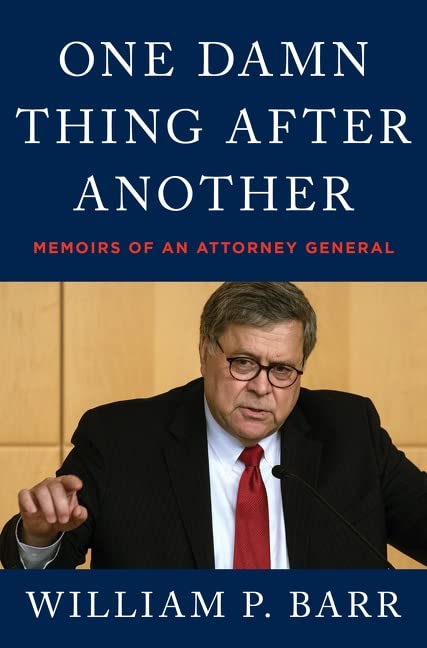
Book cover of One Damn Thing After Another

One Damn Thing After Another Summary

Humanity & Culture

By William P. Barr

William Morrow · March 8, 2022

Summary

One Damn Thing After Another by William P. Barr is a captivating book that takes readers on a journey through a series of events. The author draws from his own experiences to present a narrative filled with twists and turns. As the title suggests, it's a collection of happenings that seem to follow one another in quick succession. The book provides a unique window into the author's life and the situations he has encountered. Whether it's dealing with challenges or sharing moments of triumph, Barr's storytelling keeps the readers engaged. It's a must-read for those interested in getting an inside look at the author's world and the events that have shaped his life.

About the Author

William P. Barr is a well-known author. He focuses on writing novels. His style in "One Damn Thing After Another" is engaging, filled with vivid descriptions and a fast-paced plot, captivating readers with its unique charm.

Chapters

1

Introduction

"One Damn Thing After Another" by William P. Barr is a comprehensive account that delves into various aspects of law, government, and the political landscape. Barr, with his extensive experience in the legal and political arenas, presents a detailed and in-depth perspective on a wide range of issues. This book offers valuable insights into the inner workings of the government, the role of the law, and the challenges faced in maintaining the rule of law in a complex society.

2

The Rule of Law

The rule of law is the cornerstone of a democratic society. It ensures that all individuals, regardless of their status, are subject to the same laws. In this book, the concept of the rule of law is explored in great detail. It is emphasized that the rule of law is not just about having laws on the books but also about their fair and consistent application. A well-functioning legal system requires an independent judiciary. Judges must be free from political influence to make impartial decisions. The book discusses how the erosion of judicial independence can lead to a breakdown of the rule of law. For example, when political pressure is applied to judges, it can result in unjust rulings that undermine the trust of the public in the legal system.Moreover, the rule of law also implies that the government itself is bound by the law. This means that government actions must be based on legal authority. If the government acts outside the scope of the law, it can lead to chaos and a loss of public confidence.

3

The Role of the Attorney General

The Attorney General plays a crucial role in the legal and political system. As the chief law-enforcement officer of the United States, the Attorney General is responsible for ensuring that the laws of the country are enforced. One of the key responsibilities of the Attorney General is to represent the United States in legal matters. This includes handling cases in federal courts, providing legal advice to the President and other government agencies, and overseeing the work of federal prosecutors. The Attorney General also has a role in setting law-enforcement priorities. This involves making decisions about which types of crimes to focus on and how to allocate resources. For example, in the fight against organized crime, the Attorney General may decide to allocate more resources to investigations and prosecutions.In addition, the Attorney General is involved in policy-making. They can influence the development of laws and regulations related to law enforcement and criminal justice. This requires a deep understanding of the legal and social issues at hand.

4

Political Influence in the Legal System

In a democratic society, it is essential to maintain the separation of powers between the legislative, executive, and judicial branches. However, political influence can sometimes seep into the legal system. Politicians may try to influence legal decisions for their own political gain. This can take the form of pressuring prosecutors to bring charges against political opponents or interfering with the appointment of judges. Such actions can undermine the integrity of the legal system.For instance, if a politician tries to influence a prosecutor to drop charges against a friend or ally, it can lead to a perception of unfairness and corruption. The book examines how these types of political interferences can occur and the steps that can be taken to prevent them.One way to counter political influence is to strengthen the independence of the legal institutions. This can be achieved through measures such as ensuring the proper selection and appointment of judges and prosecutors, and by providing them with the necessary resources and support to carry out their duties without fear of political retaliation.

5

National Security and the Law

National security is a top priority for any country. The book discusses how the law plays a crucial role in safeguarding national security. In the context of national security, the government has certain powers to collect intelligence and take measures to protect the country from threats. However, these powers must be balanced with the rights and freedoms of the citizens. For example, the government may need to conduct surveillance on potential threats, but this must be done in accordance with the law. The book explores the legal framework that governs national security activities, including the use of wiretaps, search warrants, and other forms of intelligence-gathering.It also examines the challenges of balancing national security with civil liberties. In times of crisis, there is often a temptation to sacrifice civil liberties in the name of national security. However, this can lead to a dangerous precedent and a violation of the rights of the people.

4 more chapters available

Continue listening in the Spickor app — free download on the App Store.

Listen in App

Why Spickor?

At Spickor, we believe knowledge should have no paywalls. Every book summary can be unlocked for free by watching a short ad — or you can choose an ad-free subscription. Unlike other apps, there's no "1 book per day" free limit. Learn at your own pace, on your own terms.

FeatureSpickorBlinkistHeadway
Free accessAll books free via ad unlock1 book/day only1 book/day only
Book library2,200+ across 8 categories9,000+ (non-fiction only)2,000+ (personal growth focus)
Paid subscriptionNo forced subscription; ad-supportedRequired; from $99.99/yrRequired; from $89.99/yr
Audio for all summariesYesPremium onlyPremium only
Novels & fictionYesNoNo
PlatformsiOS (Android & Web in dev)iOS / Android / WebiOS / Android only

All Books, Truly Free

Unlock any book with a short ad. No daily limits, no hidden fees.

Listen for Free

Every summary includes high-quality audio. No "premium only" labels.

Beyond Self-Help

8 categories including business, technology, and novels.

Listen in App
8 m 49 s